
Getting there
Our shop is in Cokato, about 55 miles west of Minneapolis on Highway 12, which becomes I-394 into the city. The lake neighborhoods and Northeast are both an hour and change. We bring the equipment for the whole job each day, so the distance does not add days to the schedule.
The 1900 to 1930 oak and maple under Minneapolis carpet
The flooring in a Minneapolis house from that era is better wood than almost anything sold today. Old-growth red oak and maple, tight grain, 3/4 inch thick, usually 2 1/4 inch strip in the main rooms and sometimes maple in the kitchen where it was expected to take abuse. The problem is what happened after. Carpet tack strips were nailed around every room edge, pad was glued or stapled down, and pets and radiators and a century of settling left their marks. Boards along the exterior walls are often cupped from decades of winter dry air. Near old radiator positions there are rust rings and sometimes rot. Around a relocated wall or a removed built-in there is a patch of plywood or mismatched newer oak. None of this is unusual and almost all of it is fixable. The first visit is about the floor's condition, and we will tell you plainly what we found.
Board replacement and repairs before the sanding starts
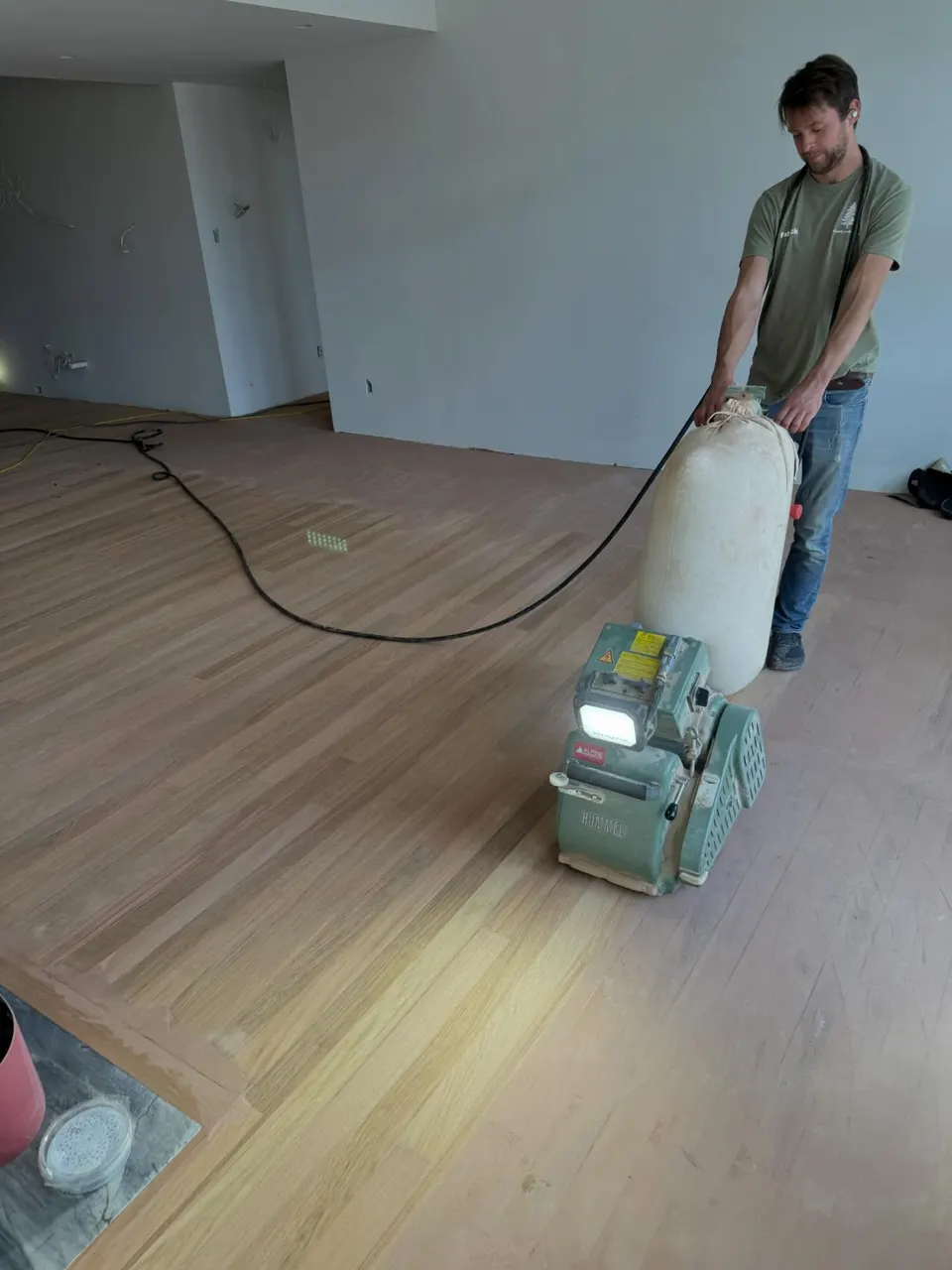
On most Minneapolis refinishes we replace boards before the first sanding pass. Damaged boards are cut out along their length, the tongue is trimmed, and new boards of the same species and width are laced in so the end joints stagger like the originals. Reclaimed old-growth oak is sometimes available for this and matches better than new stock, which has a looser grain. Where a wall was moved and the floor run changes direction, we will either weave the new boards into both runs or set a clean border, depending on the room. Then the whole floor is sanded flat, which erases the height difference between old and new. Thickness is the one limit. A floor that has been fully sanded three or four times in a hundred years may be close to the tongue, and we measure at a floor vent before committing to a full sand. If it is thin, a lighter sanding and a clear finish is the safer choice.
Stain and finish choices in a Minneapolis house
Red oak from this period takes stain well and the pink cast settles down under a medium brown. Many owners in Linden Hills and Kenwood want the floor to look like it belongs to the house rather than to a magazine, and a natural or lightly ambered finish on that oak does it. Oil-based polyurethane ambers more with time, which can suit a 1920s interior. Water-based stays clear and dries faster, which matters when you are living in the house during the work. On the maple kitchens we steer away from dark pigment stain because it blotches, and a clear coat on old-growth maple is a good floor on its own. Minneapolis also brings us the pattern work. Some of the larger homes around Lake of the Isles have original herringbone entries and borders that need repair before refinishing, and remodels in the same neighborhoods ask for new herringbone or chevron that matches the age of the house. Northeast has its own early 1900s housing, and we refinish those floors the same way.
Refinishing hardwood floors in Minneapolis
Our hardwood floor refinishing page is the place to start for a Minneapolis house. It walks through the full sand, the repair work that comes first on a 1920s floor, and the stain and finish choices that suit old-growth red oak and maple. How a refinish runs, start to finish.
Around Minneapolis
- Linden Hills
- Lake Harriet
- Lake of the Isles
- Kenwood
- Northeast
Hardwood services we bring to Minneapolis
Every hardwood service, on one page.
Questions from Minneapolis homeowners
I pulled up carpet in my Minneapolis house and found hardwood with staples and stains everywhere. Is it salvageable?
Almost certainly yes. Staples, tack strip holes and pad residue all come out in the sanding. Pet stains that have gone black into the grain are the one thing sanding cannot fully remove, and those boards get replaced. We look at the floor before quoting and tell you which boards need to go.
Can you match new boards to my 1920s oak floor where a wall was removed?
Yes. We cut back the damaged or missing area, lace in new red oak of the same width so the end joints stagger, then sand everything flat and finish it together. New oak has a slightly looser grain than old-growth, so the patch shows if you look for it in raking light. Reclaimed boards close that gap.
How many times can a Minneapolis hardwood floor be refinished before it is too thin?
A 3/4 inch solid floor can usually take four or five full sandings over its life. Many Minneapolis floors from the 1920s have had two or three already. We measure what is left above the tongue at a vent, and if there is little margin we recommend a light screen and a clear coat instead.
Do you install herringbone floors in Minneapolis homes?
Yes, both new herringbone and chevron in remodels and repairs to original pattern floors in older homes. Pattern installs take longer than plank because every piece is cut and set to a layout line, and in an old house the walls are rarely square, so we set the pattern off the room's main sight line rather than off a wall.
Nearby
We also work in Edina. Everywhere we work.