
What a builder gets from us that a one-crew shop cannot promise
A builder's framing schedule does not care that a flooring company is finishing another house. When a drywall inspection passes early or a cabinet delivery slips, the flooring window moves, and the contractor either moves with it or becomes the delay. We staff for that. Crews can be shifted between jobs so a Wayzata house that is ready on Monday gets started Monday, and a house that is not ready does not sit with our people standing in it. Just as important, the result does not depend on which crew shows up. Sanding, stain and finish are done the same way on every job, so the superintendent is not re-explaining expectations each time. Builders see the itemized scope in JobTread, know the dates we have committed to, and hear from us before a problem becomes their problem. The approved status we hold with the custom builders we work for rests on those three things.
The stage of the build we arrive at
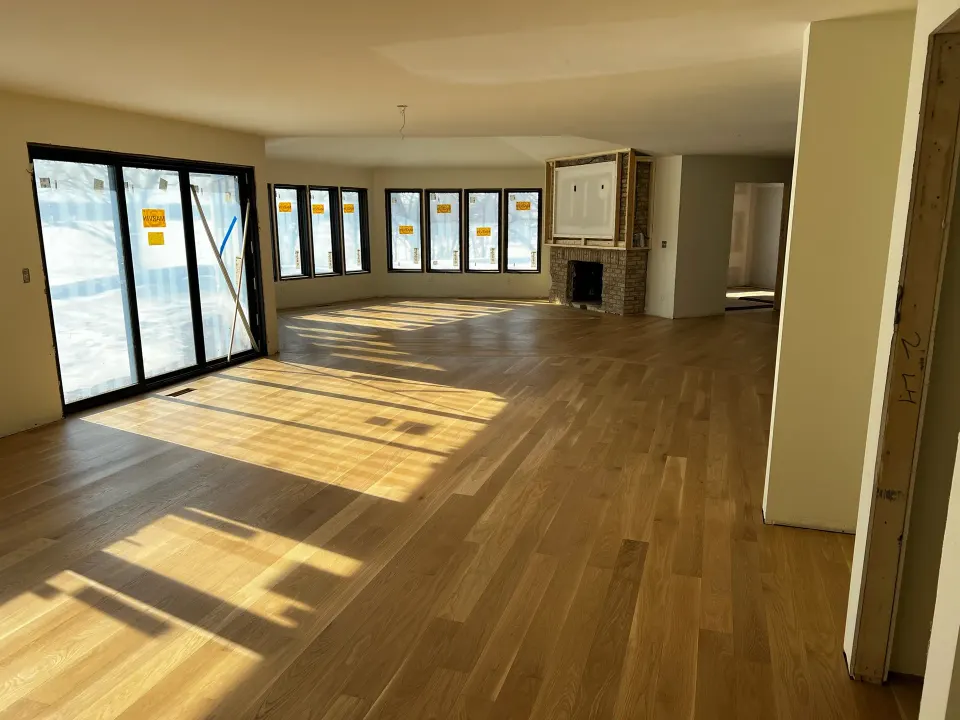
Hardwood goes in after the house is dried in, drywalled and primed, with the HVAC running and holding normal temperature and humidity. Those conditions are not optional, because the wood acclimates to whatever the house is doing and a damp, unheated shell will show up as a cupped floor in March. Depending on the builder's sequence we install either before trim and cabinets, so the base and the cabinet toe kicks land on top of the floor, or after cabinets are set, in which case we fit to them. We prefer to sand and apply the first coats before trim carpenters and painters are back in, then return for the final coat once the heavy trades are out. We walk the subfloor with the super before material is ordered and flag anything that needs fixing, so the install day is an install day and not a repair day.
Protecting the floor until the walk-through
A finished floor in an active job site is the most exposed thing in the house, and the weeks between our last coat and the homeowner's walk-through are where most new-floor damage happens. After the finish has cured we cover the floor with a breathable protection board, taped at the seams and never with plastic directly on fresh finish, which traps moisture and can mark it. We leave the builder a short set of rules for the trades that follow: no dragging appliances, no cutting on the floor, no rolling loads without plywood. On many jobs we hold the final coat until the trades are done, then come back to buff and apply it so the floor the homeowner walks into is the floor we meant to hand over. On a site-finished floor, that last coat also erases the small scuffs that always happen during trim and paint.
Itemized estimates in JobTread, for the builder and the homeowner
Builder estimates live in JobTread, broken out by room and by task: material by species and width, tear-out where there is any, subfloor prep, install, sanding, stain, finish coats, stair treads and protection. Allowances show as allowances. When a homeowner upgrades from a five inch to a seven inch white oak plank halfway through selections, the change shows up as a change to those lines and nothing else, and both the builder and the homeowner can see what moved. That same breakdown is what we use to schedule, so the dates on the estimate match the dates on the calendar. For a homeowner building with Creek Hill Custom Homes or Swanson Homes or any of the builders we are approved with, it means the flooring number in your budget is a number someone measured for, not a square-foot guess.
What drives the cost of hardwood flooring in a new build around Lake Minnetonka
The plan drives most of it. Square footage and how much of the house gets hardwood versus tile or carpet set the base, and a plan cut into many small rooms installs slower than an open one. Species, grade and width set the material line, with wide plank white oak and walnut at the top and red oak and narrower boards toward the bottom. Engineered over radiant heat on a lower level is priced differently from nailed solid upstairs. A herringbone entry or a stair package with treads and risers is its own line because it takes longer per foot. Site-finished adds the sanding and finishing days; prefinished trades that labor for a higher material cost. Floor protection, a return trip for the final coat and any subfloor correction the framing left behind round out the estimate.
When we would talk you out of it
- A house where the HVAC will not be running when the flooring window opens. We will push the install rather than nail wood into a damp shell, and we will say so early so the schedule can absorb it.
- A builder who wants the flooring contractor to also run the tile, carpet and LVP. We install and finish hardwood. We coordinate with the other flooring trades, but we do not pretend to be them.
- A spec house where the plan is the cheapest floor that passes a walk-through. We are not the right fit for that budget, and a builder is better served by a lower-cost installer than by us trying to be one.
What you get
- On site the week the builder's schedule calls for it, with crews that can shift when it moves
- The same sanding, stain and finish standard on every house regardless of crew
- Itemized estimates in JobTread, visible to the builder and the homeowner
- Subfloor walk with the super before material is ordered
- Floor protection and a return trip for the final coat after the trades are out
- Approved with the Twin Cities' top custom builders, NWFA member since 2007
How the job runs
- 1
Scope and selections
We price from the plans in JobTread, then meet the homeowner with planks to settle species, width, finish and any pattern or stair work.
- 2
Schedule and subfloor walk
We commit to the flooring window with the builder, walk the subfloor before ordering, and get material on site to acclimate with the HVAC running.
- 3
Install, sand and first coats
The floor goes in, gets sanded flat with dust containment, stained if selected, and sealed before the trim and paint crews return.
- 4
Protect, return, hand over
The floor is covered, the final coat goes on after the trades are out, and we walk it with the builder and homeowner.
Questions we get on the first call
When in the build should the hardwood go in?
After drywall and primer, with the HVAC running and the house holding normal temperature and humidity. Most builders have us in before trim and cabinets so the base sits on the floor; some set cabinets first and we fit to them. Either way the furnace or air has to be on first, or the wood will not acclimate to the finished house.
Can you move our install if the schedule slips a week?
Yes. That is the reason builders use us. We staff so crews can be shifted between houses, so a job that is ready early can start early and a job that slips does not leave our people standing in it. Tell us as soon as the schedule moves and we will re-sequence. Last-minute moves are harder, but we have made plenty.
How do you keep the other trades from wrecking the floor?
Protection board taped at the seams after the finish cures, a short list of rules left with the super, and on most jobs a final coat held until the trades are out. That last coat buffs out the trim and paint scuffs so the walk-through floor is a fresh floor. Plastic never goes directly on new finish because it traps moisture.
I am building with one of your builders. Do I deal with you or with them?
Both. Your builder holds the schedule and the contract, and you work with us on selections. We meet you with full planks, walk through species and width and finish, and the choices flow into the itemized estimate your builder can see in JobTread. If you change a selection, you will see which lines moved and your builder will too.
Do you do the stairs too?
Yes. Treads, risers, nosings and floating treads go in during the flooring phase so they are sanded, stained and finished with the floor and match it exactly. If the plan calls for under-step LED lighting, we coordinate the tread work with the electrician so the channels are ready before the treads are set.
Related hardwood services
Where we do this work
New Construction Flooring across the west metro: Wayzata, Orono, Excelsior, Chanhassen, Maple Grove, Cokato, Delano, Minnetonka, Edina and the lake towns between them. See everywhere we work.