
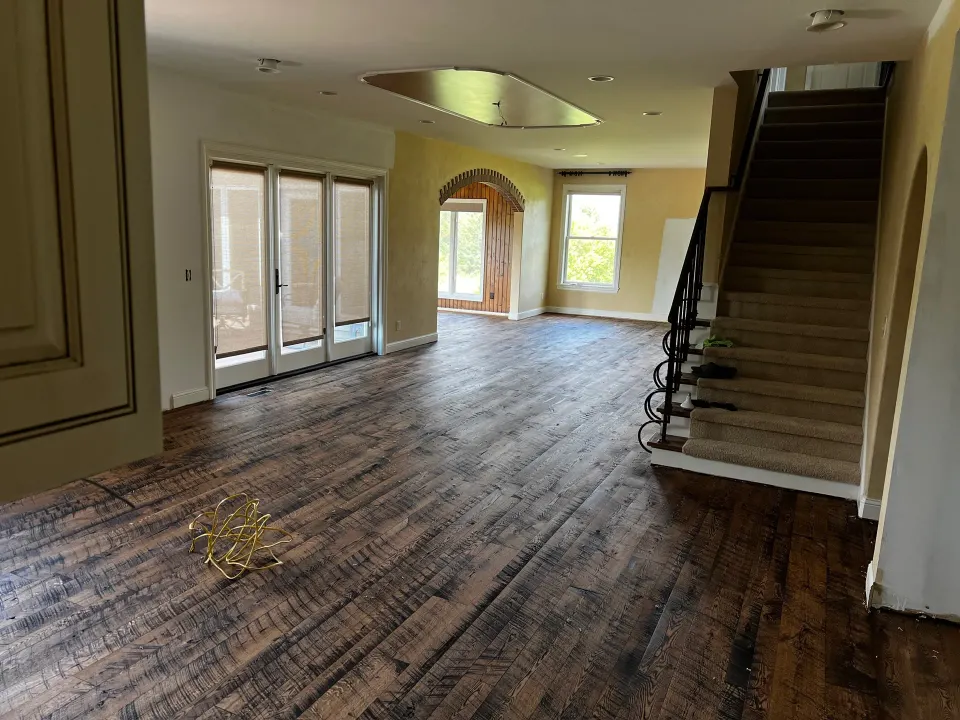
Moisture readings and what they tell us
The moisture meter is the first tool out of the truck. We read the hardwood in several spots across each room and compare it to the subfloor below where we can reach it, and the pattern tells the story. Boards that read high and cup across the width point to moisture from below, a slab or crawlspace or a slow leak. Boards that read high in one spot near an appliance or a door point to a leak or wind-driven rain. A floor that reads normal but has gaps all year was probably installed too wet and has dried to the house. Readings that are even and in range mean whatever is wrong is a finish or wear problem, which is better news. Cupped boards that have dried out can often be sanded flat; cupped boards still reading wet cannot be refinished until the source is fixed, and we will not sand them until it is.
How much wood is left to sand
A three quarter inch solid floor has about a quarter inch of wood above the tongue when it is new, and every full sanding removes a little of that. Original oak in an Edina Country Club or Minneapolis lake neighborhood house may have been sanded three or four times since the 1920s, and at some point the next sand exposes the tongue and the fasteners. We check the remaining thickness at a floor register, a threshold or a closet where we can see a board edge, and we look for the signs of a floor near its limit, such as nail heads showing and boards that have cracked along the tongue line. Engineered floors get the same check on the wear layer. The answer decides whether a full refinish is still on the table or the floor is down to a buff and coat, and eventually replacement.
Subfloor, squeaks and movement
We walk every room listening and feeling. Squeaks are fasteners that have let go or boards rubbing on each other, and they are fixable, but a squeak that comes with a soft, bouncy spot is a subfloor problem and may be a joist problem. From the basement or crawlspace we look at the underside where we can: the subfloor type and thickness, water staining, whether the joists have been notched or cut for plumbing, and whether the floor system is adequate for the span. We note gaps, crowning, cupping and any boards that have split or lifted, and whether the finish has worn through to bare wood in the traffic lanes. On a floor somebody is thinking about replacing, this is also where we check whether the subfloor can take a new nail-down floor or whether it needs work first.
What the written report says
You get a short written report, usually within a few days of the visit. It lists the moisture readings by room and what they indicate, the remaining thickness and how many sandings the floor has left, the subfloor findings and anything we saw that is structural or a leak and belongs to another trade. Then it says which of four paths fits: a buff and coat if the finish is worn but not through, a full refinish if it is through to wood or you want a color change, a repair if the problem is a few boards or one room, or replacement if the floor is too thin or too damaged to save. Each path comes with an itemized estimate so you can compare them on the same page. If the honest answer is that the floor needs nothing but a cleaning and a humidifier, the report says that too.
What drives the cost of the work a hardwood floor inspection recommends
The inspection itself is the small line. The work it recommends is priced on what we found. A buff and coat is priced on square footage and the finish system. A full refinish adds sanding time, which rises with the floor's condition, plus stain if you want a color change and the number of finish coats. Repairs are priced by the board count and whether the species and width are still available to match, with old growth 1920s red oak harder to find than new. Replacement is priced like any new install, with tear-out of the old floor added. Across all four, a moisture problem that has to be fixed first, subfloor repair and furniture moving add lines. The report puts each path side by side with its own estimate so you are comparing the same scope.
When we would talk you out of it
- A floor you already know needs a full refinish. If the finish is gone in the traffic lanes and the color is tired, skip the inspection and book the refinish; we check thickness and moisture at the start of that job anyway.
- A structural or insurance opinion. We will tell you what we see in the floor system and when to call an engineer or a plumber, but the report is a flooring assessment, not an engineering letter or an insurance adjustment.
- A floor under three layers of carpet, vinyl and particleboard. We can look at what is exposed and tell you what is likely under there, but a real assessment of the hardwood has to wait until it can be seen.
What you get
- Moisture readings across each room, compared against the subfloor
- Remaining thickness checked so you know how many sandings are left
- Subfloor, squeak and movement check from above and below where possible
- A written report that names one of four paths and prices each
- Honest answers, including that the floor only needs a buff and coat
- Pre-purchase inspections for home buyers before closing
How the job runs
- 1
Tell us what you are seeing
Cupping, gaps, soft spots, wear or a purchase decision. The symptom helps us know where to look first.
- 2
Visit and measure
Moisture readings room by room, remaining thickness at a register or threshold, and a walk of every floor listening for movement.
- 3
Look from below
Where there is a basement or crawlspace we check the subfloor, joists and any staining from underneath.
- 4
Written report and estimates
A short report with the findings, the path we recommend out of buff and coat, refinish, repair or replace, and an itemized estimate for each.
Questions we get on the first call
How do I know if my hardwood floors can be refinished again?
We measure how much wood is left above the tongue at a register or threshold. A new solid floor has about a quarter inch; each full sand removes a small part of that. Exposed nail heads, splits along the board edges and a floor sitting below the adjacent tile are signs it is near the end. The report gives you the number.
Why are my hardwood floors cupping?
Cupping, where the edges of each board sit higher than the center, means the bottom of the board is wetter than the top. The moisture is coming from below: a slab, a crawlspace, a leak or high basement humidity. The source has to be fixed before the floor is sanded, or it will cup again under the new finish.
Can you inspect the floors in a house we are buying?
Yes. We do the same visit for buyers, usually during the inspection period, with the seller's permission to pull up a register and check thickness. You get the moisture readings, the remaining thickness, the subfloor notes and an estimate for whatever the floor needs, which is useful at the negotiating table and in planning the move-in.
Do I need an inspection or can you just quote a refinish?
If you already know you want a refinish, book the refinish; we check thickness and moisture at the start of every one. The inspection is for when you are not sure what the floor needs, when there is cupping or soft spots, or when you want to compare refinish against replacement with real numbers for each.
Related hardwood services
Where we do this work
Floor Inspection across the west metro: Wayzata, Orono, Minnetonka, Excelsior, Edina, Eden Prairie, Chanhassen, Plymouth, Maple Grove and the lake towns between them. See everywhere we work.