
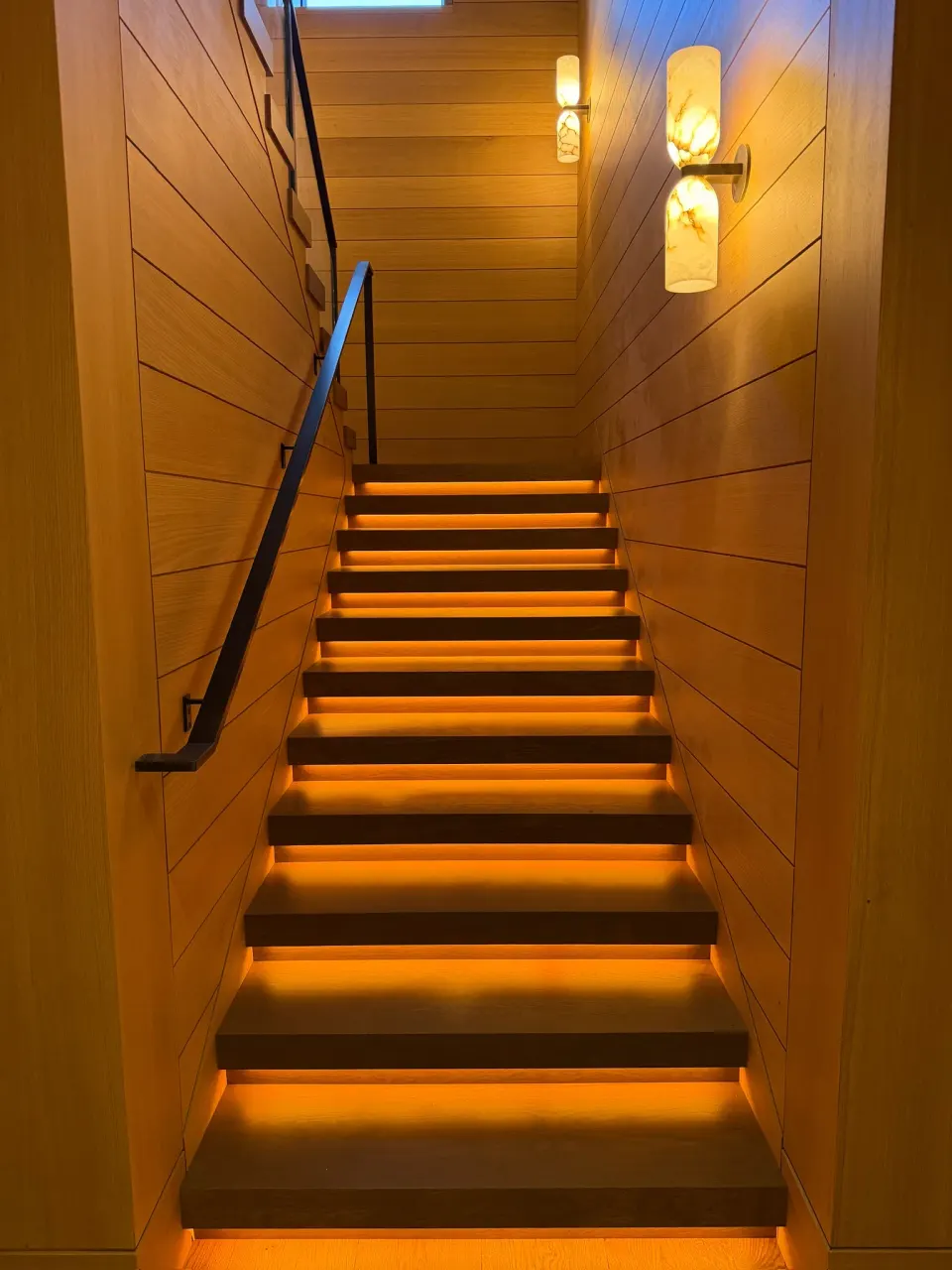
Treads, risers and nosing, and the carpet-to-hardwood conversion
A closed staircase has three parts. The tread is the step itself, cut from the same species as the floor, with a rounded or square nosing that overhangs the riser. The riser is the vertical face, which we do in matching hardwood or in paint-grade material for a white riser against a wood tread. The landing gets its own transition so the plank meets the top step cleanly. Converting carpeted stairs is the most common version of this job. We pull the carpet, pad, tack strip and every staple, then look at what is under it. Builder stairs are usually pine or plywood treads that were never meant to be seen, so we either cap them with a false tread or remove and replace them, depending on the height we have to work with at the top and bottom step. Each step is measured and templated on its own, because no two steps in an older house match.
Floating treads and LED under-step lighting
Open staircases, the kind with glass or cable railings and no risers, use thick solid treads that cantilever from a stringer or wall. We build these from laminated stock in the species of the floor, square-edged, and set them to the structure the framer or steel fabricator provided. Curved staircases take the same approach with each tread cut to its own radius. Under-step LED lighting has become a regular request on these, and the detail has to be planned before the treads go on: the channel is routed into the underside or the nosing, the electrician pulls the wire while the stair is still open, and the tread is set over it. We have done this on straight runs, on curved staircases and on an enclosed oak stair where the strip sits under each nosing. It is the sort of thing that looks simple when it is done right and cannot be fixed cheaply after the fact.
Matching the stain and finish to the main floor
The stair reads wrong when it is close to the floor color and not on it. When the treads and the floor are installed together, that is easy, because they get the same sanding sequence, the same stain mixed in the same batch and the same finish on the same day. When the stair is being added to an existing floor, we match it. That means sampling the floor's current color, which has usually shifted with age and sun, and mixing a stain on raw stock from the same species until a sample board disappears against the floor in daylight. Sheen matters as much as color, so we match the finish type too. On a prefinished floor we can often order matching treads and nosings from the same product line, or finish unfinished treads to the factory color. Treads see more wear than any square foot of floor, so we keep the coat count up.
What drives the cost of hardwood stair treads in the Twin Cities
The step count and the stair type matter more than anything. A straight closed run of thirteen steps with capped treads and painted risers is the baseline. Floating treads cost more per step because they are thick laminated stock, cut to the structure and often finished on all faces. Curved stairs add templating time for every tread. Carpet removal and repairs to the pine treads underneath are their own line. Matching species to a walnut or hickory floor costs more than red oak. Hardwood risers cost more than paint-grade, and a landing or a return nosing on an open side adds material and fitting time. Under-step LED channels, a stain match to an existing floor and finishing the treads separately from the main floor each add to the estimate, and we list them separately.
When we would talk you out of it
- A stair where the headroom or the top step height cannot absorb a thicker tread. Capping an existing tread raises each step, and if the top or bottom riser ends up out of code we will tell you the stair needs rebuilding instead.
- A rental or a basement stair where carpet is doing a job. Carpeted stairs are quieter and softer underfoot, and if that is what the space needs, new carpet is the honest answer.
- A floating stair with no structure behind it. We set treads to a stringer, wall bracket or steel the framer or fabricator provided. We do not engineer the support, and we will not hang treads on something that was not built to carry them.
What you get
- Treads, risers and nosings in the species of your floor
- Carpet-to-hardwood conversions with every staple pulled
- Thick floating treads for open, glass-railed and curved staircases
- Under-step LED lighting coordinated with the electrician before the treads go on
- Stain mixed to match the floor, on a sample board checked in daylight
- Finished together with the main floor whenever the schedule allows
How the job runs
- 1
Measure every step
We measure rise, run and width step by step, check what is under any carpet, and confirm the top and bottom heights work with the new tread.
- 2
Order and prepare the stock
Treads, risers and nosings come in the species and thickness the stair needs, including laminated stock for floating treads.
- 3
Remove and set
Old carpet or treads come out, the structure is checked, and each tread is cut to its template and set with adhesive and fasteners.
- 4
Sand, stain and finish
Treads are sanded, stained to the floor's color and coated with the same finish, ideally on the same days as the floor.
Questions we get on the first call
Can you replace carpeted stairs with hardwood to match my floor?
Yes, this is the most common stair job we do. We remove the carpet and staples, look at the pine or plywood treads underneath, and either cap them with hardwood or replace them. Then the new treads are stained to match your floor on a sample board before anything is finished in place.
How long does a stair tread installation take?
A straight closed staircase usually takes a day or two to remove and set, plus the finishing days, which run with the main floor if we are doing both. Floating and curved stairs take longer because every tread is templated and cut on its own. Stairs are out of service during finishing, so we plan around how you get upstairs.
Can the stair lights go in after the treads?
Not well. Under-step LED needs a routed channel and a wire path, and both have to be in place before the tread is set. If lighting is even a maybe, tell us during planning and we will coordinate with the electrician so the channel and the wire are ready. Adding it later means pulling treads.
Will the new treads be slippery?
A satin or matte finish on hardwood treads gives about the same grip as a hardwood floor, and most people get used to it in a day. High-gloss finishes are slicker, so we steer away from them on stairs. If you have small kids or an older parent in the house, a runner down the center is an easy addition after the fact.
Related hardwood services
Where we do this work
Stair Treads across the west metro: Wayzata, Excelsior, Plymouth, Orono, Minnetonka, Edina, Eden Prairie, Chanhassen, Maple Grove and the lake towns between them. See everywhere we work.