
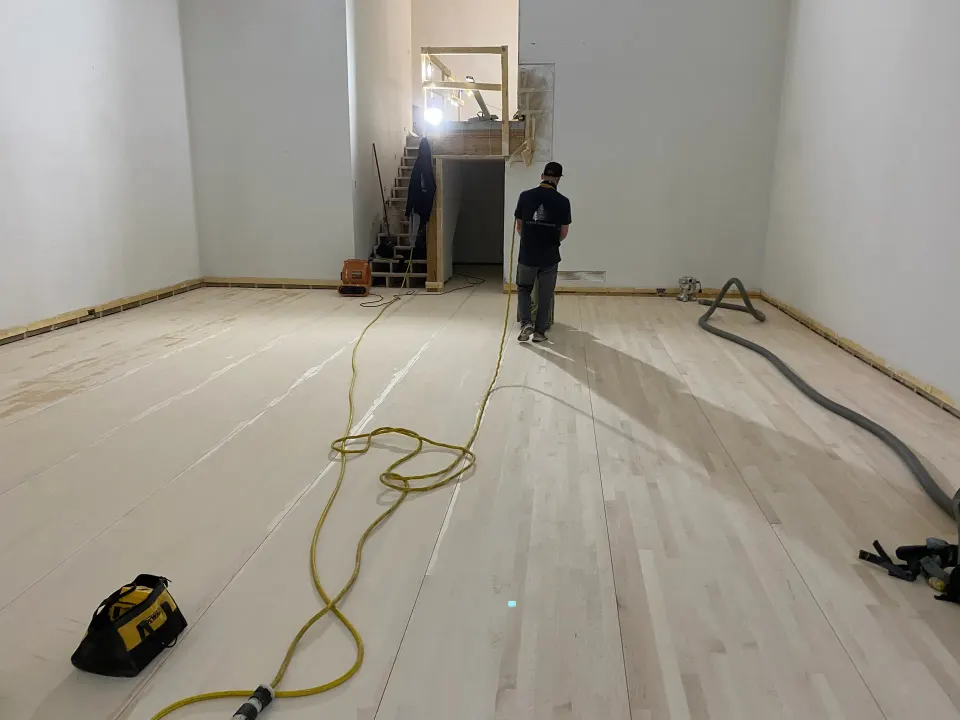
Part of hardwood floor refinishing: sanding, stain, finish and repair for floors that are already down.
How we sand a hardwood floor flat
We start with a coarse grit that cuts off the old finish and levels the floor, then step through finer grits until the scratch pattern from the previous pass is gone. Skipping a grit saves an hour and shows up forever as swirl marks under the finish, so we do not skip. The big machine handles the open field. An edger takes the strip along the walls, and corners, closets and the space under cabinet toe kicks get hand scrapers and detail sanders. The edger and the big machine leave different scratch patterns, so the last step is blending them with a buffer and a fine screen so the floor reads as one surface. Before any stain or finish goes down we check the floor under raking light, because a flaw you cannot see standing up shows plainly once a coat of finish is on it.
Sanding a new floor versus an old one
A new site-finished floor is the easy case. The boards are already flat and the sanding is there to take out the slight height differences between boards and leave a uniform surface, so very little wood comes off. An old floor is different work. Old finish loads the abrasive quickly, so paper gets changed more often. Carpet staples, tack strips and raised nail heads have to come out or be set below the surface before a machine touches the floor, or they tear the belt. Pet stains and black water marks go deep into the grain, and sanding lightens them without always removing them. Floors that were waxed or oiled can gum the paper and need a cleaning pass first. Old filler from a previous refinish pops loose and gets replaced. Every one of these adds time, and every one is something we look for before we quote.
Species that behave differently under the sander
Hard maple is the one that catches people. It is dense and close-grained, so it burnishes instead of cutting if the abrasive is dull, and every swirl scratch shows under a clear finish because there is no grain pattern to hide it. Maple takes a slower, more careful grit sequence and sharp paper throughout. White oak and hickory are hard too, but their open grain forgives small scratches. Red oak sands easily and is the floor most of the 1980s and 1990s two-stories in Eden Prairie and Chanhassen were built on. Old-growth oak in a Minneapolis house from the 1910s is denser than new oak and cuts slower. Soft species like pine and fir dish out under a heavy machine and want a lighter touch. We adjust the sequence to the wood under us, which is one reason we look at the floor before we price it.
What drives the cost of hardwood floor sanding in the west metro
Square footage sets the base, and the layout adjusts it. Open rooms sand quickly. Hallways, closets and rooms broken up by cabinets and islands are mostly edger and hand work, which is slower per foot. Condition is the next factor. Old finish, wax, carpet adhesive, staples and filler all add passes or prep. Species matters because maple and old-growth oak cut slower than new red oak. Stairs are priced per tread. If the floor needs repairs or board replacement first, those are itemized separately. Sanding is almost always quoted together with the finish coats as a refinish, since bare wood should not sit open for long, so the finish choice changes the total as well. A builder's new site-finished floor is quoted by the foot as part of the install.
When we would talk you out of it
- The finish is intact and only dull. A screen and recoat stays above the wood and is a better use of your money than a full sand.
- Thin engineered veneer. A full sand can cut through the wear layer, and we will not run a big machine over a floor that cannot take it.
- Sanding alone with no finish to follow. Bare wood left open for weeks picks up stains and moisture, so we sand and coat as one job unless a builder's schedule calls for a gap.
What you get
- Flat, even floor with no drum marks or dishes
- Full grit sequence, no skipped steps
- Edges, corners and closets finished by hand
- Vacuum extraction on every machine for dust containment
- Checked under raking light before finish goes on
- Same sanding standard on a refinish as on a new builder floor
How the job runs
- 1
Prep
Furniture out, staples and tack strips pulled, nail heads set, doorways sealed and the furnace off.
- 2
Coarse cut
The first pass takes off old finish and levels the floor. On a new floor this is a light cut that only removes the height differences between boards.
- 3
Finer grits and edges
We step through finer grits until the scratch pattern is gone, run the edger along walls, hand-finish corners and closets, then blend edges and field with a buffer.
- 4
Inspection and cleanup
Raking light check, then two full vacuum passes and a tack before stain or finish goes on.
Questions we get on the first call
Will sanding get rid of pet stains?
Sometimes, and we will not promise it. Light stains in the finish come off with the finish. Dark or black stains mean urine reached the wood and reacted with the tannin, and those can run deeper than any sand can safely go. We sand and see how much lightens, then talk about a bleaching treatment or replacing the boards. Dark stain colors hide what remains better than a natural finish does.
How much wood does sanding take off my floor?
A full sand removes a small fraction of an inch, enough to get below the old finish and the scratches. A solid 3/4 inch floor starts with about a quarter inch above the tongue, so a carefully sanded floor can be done several times over its life. Aggressive past sandings use that up faster, which is why we measure at a register before quoting an old floor.
Do you sand the corners and closets by hand?
Yes. The big machine cannot reach within several inches of a wall, and the edger cannot get into a corner or under a toe kick, so corners, closets and the strip under cabinets get hand scrapers and detail sanders. The edges then get blended into the field with a buffer so the whole floor reads as one surface. Skipping this is what leaves a visible frame around a room.
How dusty is floor sanding?
Less than people expect and more than zero. Every machine runs on vacuum extraction, doorways get sealed and the furnace stays off, so most dust is caught at the sander. Fine dust still settles on the trim in the room we are working in and a little gets past the plastic. Plan on wiping sills in the next room and changing the furnace filter when we are done.
Related hardwood services
Where we do this work
Floor sanding across the west metro: Wayzata, Orono, Minnetonka, Excelsior, Edina, Eden Prairie, Chanhassen, Plymouth, Maple Grove and the lake towns between them. See everywhere we work.