
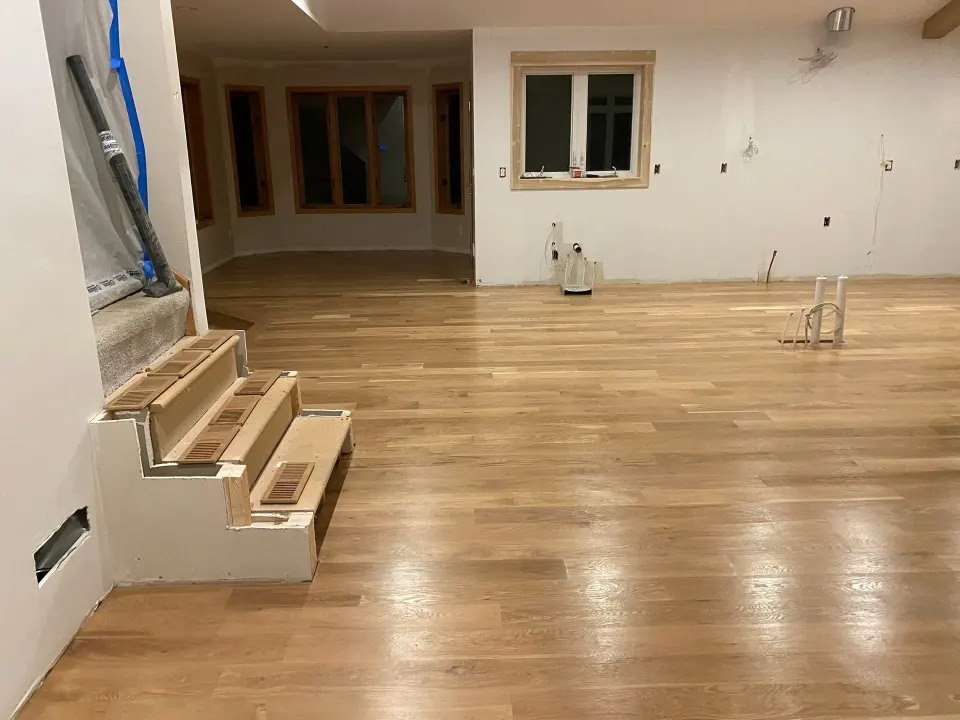
The refinish-or-replace test we run first
We measure before we recommend. On a solid floor, we pull a heat register or look at a threshold and measure the wood above the tongue, because that is what a sander has to work with. On an engineered floor, we find the wear layer thickness, either from a leftover plank or by looking at an exposed edge. Then we look at how much of the floor is damaged. A few bad boards get replaced inside a refinish. Damage across a third of the floor tips toward replacement. We check the subfloor for soft spots and movement, since a refinish on a bouncy floor is money spent on the wrong layer. Last, we ask what you want the floor to be. If the answer is wider planks, a different species, a herringbone pattern, or a floor that can go over the radiant heat you are adding, refinishing cannot get you there and we say so.
How many times a hardwood floor can be sanded
A new solid 3/4 inch floor has roughly a quarter inch of wood above the tongue. A careful full sand removes a small fraction of that, so a floor can take several in its life, which is why oak floors from the 1920s are still around. The trouble is that not every past sanding was careful. Older machines cut hard, and a floor that was flattened aggressively twice in the 1960s may have less left than a floor sanded four times gently. Edges wear thinnest because edgers cut faster than the big machine. The sign that a floor is at the end is nail heads showing or a fastener that pings off the belt. Engineered floors are a shorter story. A thick sawn-face wear layer can be fully sanded once or twice. A thin veneer wear layer can take a screen and recoat and nothing more, and sanding it exposes the plywood core. We will tell you which you have.
When replacement wins
Replacement is the right call when the floor is too thin to sand, when damage runs across most of the floor, or when the floor is the wrong product for the room. The last one comes up in Lake Minnetonka remodels more than people expect. A solid floor over new in-floor radiant heat moves too much, a solid floor glued to a basement slab cups, and in both cases an engineered floor is the honest fix. Replacement also wins when the old floor cannot be matched for an addition, so that sanding and staining old and new together would still leave a visible line, and when you want a change the old floor cannot give, like wide plank white oak in a house full of 2 1/4 inch red oak strip. A full refinish that fights all of those problems costs real money and still leaves you with the floor you did not want.
What a tear-out involves
Tear-out is louder and dirtier than a refinish, and it takes longer. We pull the base shoe or base, then lift the old floor row by row. Nailed solid floors come up in pieces. Glued-down floors fight back and leave adhesive on the subfloor that has to be scraped or ground off before anything new goes down. Every staple and cleat comes out of the subfloor. Then we look at what is under it, because this is the one chance to fix it. Plywood or OSB with soft spots gets replaced, high and low areas get flattened, and squeaks get screwed down. Old floors over diagonal plank subflooring in a Minneapolis house often need a layer of plywood added. New material is delivered and acclimates in the house before install. Plan on the room being out of use longer than a refinish would take, and the install itself runs on the same schedule as new construction.
What drives the cost of replacing a hardwood floor in the Twin Cities
Replacement is a tear-out plus a new install, so it carries both costs. The tear-out side depends on whether the old floor is nailed or glued, since adhesive removal is slow, and on what the subfloor needs once it is exposed. The install side is the same as any new floor. Square footage, species, solid versus engineered, plank width, prefinished versus site-finished and pattern all move the number, and a herringbone or a border costs more in labor than straight plank. Stairs are per tread. Disposal is a line in the estimate. Furniture moving and appliance disconnects are itemized if we do them. We give an itemized written estimate after we have measured the floor and looked at what is under it, and we tell you plainly if a refinish would have done the job.
When we would talk you out of it
- The floor still has wood above the tongue and the damage is wear rather than structure. Refinishing gives you a new-looking floor for a fraction of a replacement, and we will measure to prove it.
- You want a new color. A full sand gets you any color the species will take. Replacing a floor for color alone throws away good wood.
- Old-growth oak or maple in a 1900 to 1930 house. That wood cannot be bought new. If it is thick enough to sand, we restore it.
What you get
- Measured thickness before anyone says replace
- Refinish quoted alongside when it is still an option
- Subfloor fixed while it is exposed
- Any species, width or pattern the room calls for
- Engineered over radiant heat and slabs, solid where it belongs
- Same crews and finish standard as our new-construction work
How the job runs
- 1
Measure and decide
Thickness at a register, wear layer on engineered, damage mapped, subfloor checked. You get the refinish-or-replace call in writing.
- 2
Choose the new floor
Species, width, solid or engineered, prefinished or site-finished, pattern. Sample boards and full planks at the shop by appointment.
- 3
Tear-out and subfloor
Old floor out, fasteners and adhesive removed, subfloor repaired and flattened. New material acclimates in the house.
- 4
Install and finish
New floor installed on the same schedule as a new build, sanded and finished on site or prefinished, trim back on, walkthrough.
Questions we get on the first call
How do I know if my hardwood floor needs to be replaced or just refinished?
Measure the wood above the tongue, which we do at a heat register on the first visit. If there is enough left and the damage is wear, scratches or an old color, refinish. If nail heads are showing, the damage covers most of the floor, the subfloor is failing, or the floor is the wrong product for the room, replace. Most floors we look at land on the refinish side.
Can you install the new floor over the old one?
Sometimes, and we usually advise against it. Laying new hardwood over old raises the floor height, which creates problems at doors, stairs and appliances, and hides any subfloor issue that was the reason the old floor failed. Thin engineered or a floating floor over a sound old floor can work in a basement or a condo. Everywhere else, the old floor comes out.
How long does hardwood floor replacement take?
Longer than a refinish. Tear-out and subfloor work take a day or more depending on size and whether the old floor was glued. Then the new material needs to acclimate in the house before install, and the install itself runs three to five days on site for a typical house, longer for patterns. Site-finished floors add sanding, finish coats and cure time after that.
Can we match the new floor to the hardwood in the other rooms?
If the other rooms can take a sand, yes, by sanding and finishing everything together as one floor, which is the only way to get a true match. Species and width have to match first. If the existing floor is too thin to sand or is prefinished, we get close with stain and a transition at the doorway, and we show you a sample before you decide.
What happens to the subfloor when you tear out the old floor?
It gets inspected and fixed, which is the main reason to tear out rather than cover over. We pull every staple and cleat, scrape adhesive, replace soft or delaminated sheets, flatten high and low spots and screw down squeaks. Older houses with diagonal plank subfloors often get a layer of plywood so the new floor has a flat, solid base.
Related hardwood services
Where we do this work
Floor replacement across the west metro: Edina, Eden Prairie, Minneapolis, Wayzata, Orono, Minnetonka, Excelsior, Chanhassen, Plymouth and the lake towns between them. See everywhere we work.