
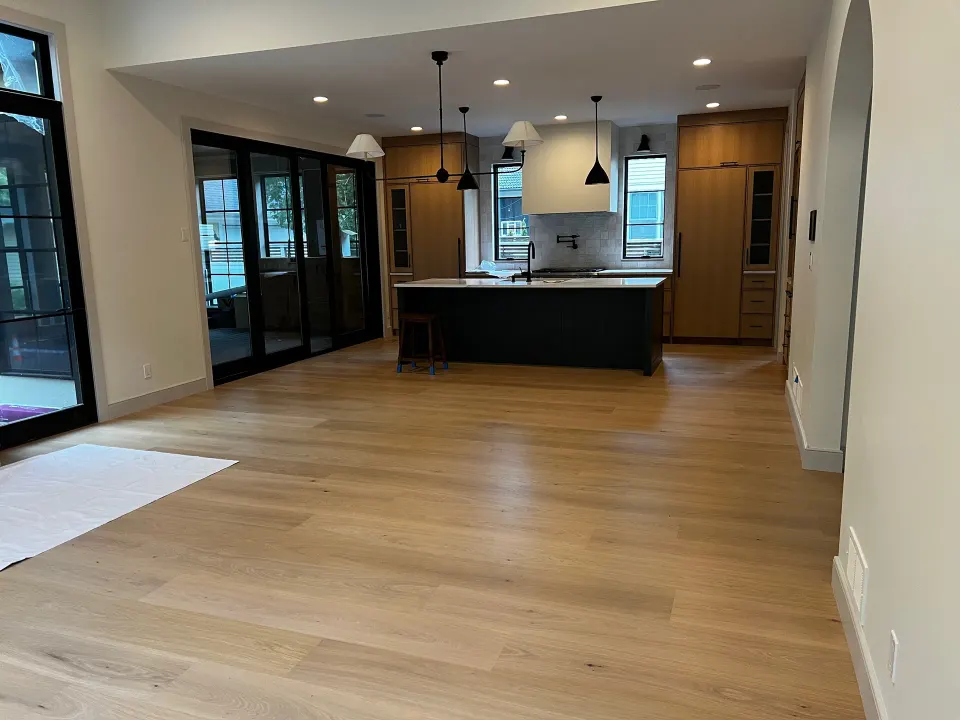
Where engineered hardwood is the right call in Minnesota
There are four rooms where we recommend engineered over solid almost every time. Over in-floor radiant heat, because the heat dries the wood from below and a solid board would cup and gap more than the manufacturer or you would accept. On a concrete slab, including slab-on-grade houses and most condos, because there is nothing to nail into and the slab gives off moisture. In a walkout or finished basement, where ground moisture and the cooler floor work against solid wood even when the room is dry. And anywhere the plank is wider than about eight inches, because a wide engineered board stays flatter through the humidity swing than a wide solid one. Outside those cases, on a plywood subfloor on the main floor, solid is usually the better long-term choice, and we will tell you so.
Wear layer thickness and what it means for refinishing later
The wear layer is the real wood on top, and it is the number to ask about before anything else. A two mm veneer is a prefinished floor you can buff and coat but should not expect to fully sand. A three mm wear layer gives you one careful full sand down the road. At four mm and up, usually sawn rather than peeled, you can sand the floor once or twice and treat it almost like solid. Thicker wear layers cost more and are worth it on a main floor that will see decades of traffic. On a guest level that sees a few weekends a year, a thinner layer is a reasonable place to save. We write the wear layer on the estimate so there is no guessing later about what the floor can take.
Installing over in-floor radiant heat
Radiant heat and hardwood get along fine when the sequence is right. The system has to be on and running at normal temperature for a stretch before the wood arrives, in a new build long enough to drive the construction moisture out of the slab or the gypsum pour. The material acclimates with the heat on, and we check moisture on both the wood and the substrate before starting. Most manufacturers set a surface temperature limit in the low 80s, and the thermostat setup should respect it. Glue-down is the usual method over a heated slab because the adhesive carries heat better than an air gap under a floating floor. In a lake house with a wall of south glass, the heat and the sun both work on the floor, so we talk about sheen and color choices that age well in that light.
Glue-down, float or nail-down
The subfloor and the product decide the method. Over concrete we glue the floor down with a urethane adhesive that doubles as a moisture barrier, after testing the slab and grinding it flat. The result is solid underfoot and quiet. Floating floors click or glue at the tongue and sit on a pad; they go in fast and suit a condo with a sound rating to meet, but they can feel hollow and they do not take a full sand as well. Over plywood, a thicker engineered board can be nailed or stapled like solid, which is our preference on a main floor because it is the quietest and most repairable install. Transitions to tile, stair nosings that match the plank and a flush vent or two finish the job. We confirm the method on the estimate so there is no surprise about what you are walking on.
What drives the cost of an engineered hardwood floor installation in the Twin Cities
The board itself drives most of it. Wear layer thickness and plank width move the per-foot price, as do the species and whether the finish is a standard factory urethane or a hardwax oil, and a sawn four mm white oak plank costs considerably more than a peeled two mm one. The install method is next. Glue-down over concrete adds adhesive and slab prep, with more labor per foot than a nail-down over plywood; floating is the quickest. Radiant heat adds time for acclimation and checks rather than material. Subfloor work, from grinding a slab flat to leveling a plywood deck, is its own line. Tear-out of the old floor, stair nosings and a site-applied finish on an unfinished product each get itemized so you can see what is driving the total.
When we would talk you out of it
- A dry main floor on plywood where you want a floor to sand for fifty years. Solid hardwood gives you more wood to work with for the same money, and nailed solid is the quieter floor.
- A basement with active moisture. Engineered handles normal below-grade conditions; it does not handle a slab that reads wet on the meter or a wall that weeps in spring. Fix the water first or pick a different material.
- A thin-wear-layer product where you plan to change the color later. A two mm veneer is a buff and coat floor. If you want a stain change in ten years, buy the thicker wear layer now.
What you get
- The usual choice over radiant heat, on slabs and in walkouts across the area
- Wide planks that stay flatter through the winter humidity drop
- Glue-down, floating and nail-down methods matched to the subfloor
- Slab moisture testing and flattening before any adhesive goes down
- Wear layer thickness written on the estimate
- Prefinished for speed or unfinished for a custom site finish
How the job runs
- 1
Match the product to the room
We look at the subfloor, the heat source and the plank width you want, then recommend a wear layer and install method.
- 2
Test and prep the substrate
Moisture readings on the slab or plywood, grinding or leveling, and the heat on and stable before the wood arrives.
- 3
Acclimate and install
Material settles in the rooms with the HVAC running, then goes in by glue, nail or float with an expansion gap at every wall.
- 4
Transitions and walk-through
Stair nosings, reducers and vents go in, and on an unfinished product the floor gets its site finish before we hand it over.
Questions we get on the first call
Can engineered hardwood go over in-floor heat?
Yes, and it is what we recommend over radiant heat. The cross-ply core keeps the board stable while the heat dries it from below. The system needs to be running before the wood arrives, the wood needs to acclimate with the heat on, and the surface temperature should stay under the limit the manufacturer sets, usually in the low 80s.
Can engineered floors be refinished?
It depends on the wear layer. Two mm is a buff and coat floor. Three mm can take one careful full sand. Four mm and up can be sanded once or twice, almost like solid. Ask for the wear layer before you buy, and if a future color change matters to you, pay for the thicker layer now.
Is engineered hardwood real wood or laminate?
Real wood. The top layer is sawn or sliced from the species you picked, white oak or walnut or hickory, and it looks and wears like solid wood because it is. Laminate is a printed photo of wood on a fiberboard core. The difference shows the first time you try to sand or repair the floor.
Should I glue down or float the floor in my walkout?
Glue-down, in most cases. A floor glued to a flat, dry slab feels solid underfoot, stays quiet and can be sanded later because it does not flex. A floating floor goes in faster and is easier to remove, which has its place, but it can sound hollow and a full sand on a floating floor is harder to do well.
Can I get a wide plank engineered floor in a custom stain?
Yes, two ways. Several suppliers finish wide plank white oak in a long list of factory colors, and we bring full planks so you can see them in your light. Or we install an unfinished engineered plank with a thick wear layer and sand, stain and finish it in the house, which gets you any color and a floor with no bevels.
Related hardwood services
Where we do this work
Engineered Hardwood Install across the west metro: Wayzata, Orono, Minnetonka, Eden Prairie, Chanhassen, Maple Grove, Delano, Buffalo, Excelsior and the lake towns between them. See everywhere we work.