
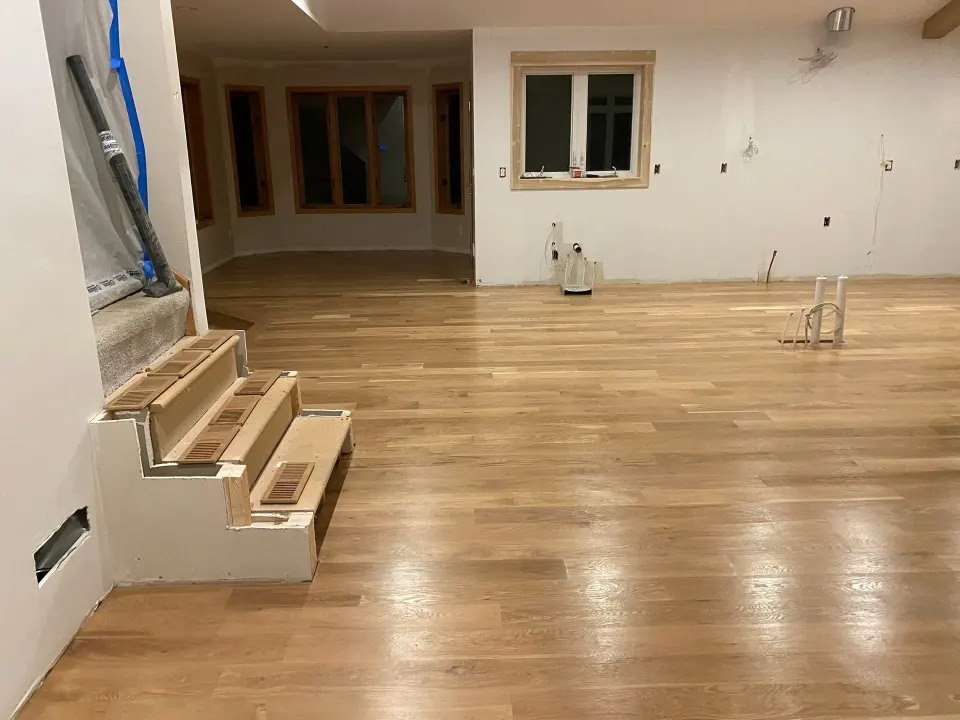
Why solid hardwood still makes sense on a plywood subfloor
Most of the houses we work in have a plywood or OSB subfloor over wood joists on the main and upper floors, and that is exactly where solid hardwood belongs. It is nailed down, so it stays quiet underfoot and never relies on adhesive or a click joint. It can be sanded many times because there is a quarter inch of wood above the tongue, where an engineered floor gives you one or two sandings at best. Site-finishing it lets you pick any stain and any sheen, and the finished surface has no bevels to catch dirt. The trade-off is movement. Solid wood shrinks in the dry Minnesota winter and swells in summer, so the install has to account for that with acclimation and a proper expansion gap at the walls. On a slab, over radiant heat or below grade, we steer you to engineered instead.
Species we install most and how each one takes stain
White oak is the species we install more than any other right now. It is hard (1,360 on the Janka scale), it takes stain evenly, and its tight grain reads well in both the light natural finishes and the deeper browns. Red oak is close in hardness at 1,290 and costs less, with a pink cast that shows through lighter stains. Hard maple is harder still at 1,450, but it blotches under dark pigment stains, so we recommend keeping maple natural or close to it. Hickory tops the domestic list at 1,820 and has strong color swings between sapwood and heartwood, which some people love and some do not. Black walnut is softer at 1,010 and gets its dark color from the wood itself, so it works best in rooms that see less traffic. We bring full planks of each so you can see them in your own light.
Nail-down installation and the winter gap question
Each board is blind-nailed through the tongue with a flooring nailer, on a spacing that holds the board flat without splitting it. Before that happens the material sits in the house until its moisture content lines up with the subfloor, which we confirm with a meter rather than a calendar. We rack boards from several bundles at once so the color and grain spread out instead of clumping. A gap at every wall gets covered by the base and shoe. Every solid floor owner notices the same thing in February. The thin lines that open between boards in the dry months are normal and close again by summer. What is not normal is a floor that gaps year-round, which usually means it went in too wet, or wide cupping, which means moisture from below. A humidifier on the furnace keeps winter gaps small.
What drives the cost of a solid hardwood floor installation in Minnesota
Species and grade set the material price. White oak and hickory cost more than red oak, walnut more than all of them, and a clear grade with few knots costs more than a character grade. Plank width pushes the price up too, since wide boards cost more per square foot and need more care in the install. The square footage and how it is divided matter: an open plan is quicker than a cut-up upstairs with six closets. Tear-out of the old floor and subfloor flattening each add labor. The finish adds its own lines, with custom stain or a hardwax oil costing more than a standard water-based system. Stair treads and borders are priced separately. We put every one of those on the estimate as its own line.
When we would talk you out of it
- A slab-on-grade house or a finished basement. Solid wood nailed to plywood is the method; there is no plywood on a slab and the moisture below grade works against it. Engineered hardwood is the answer there.
- A floor over in-floor radiant heat. Solid boards over heat move more than most people want to live with, especially in widths over five inches, and engineered handles it better.
- A plank wider than eight inches if you want it dead flat all year. Wide solid boards will show seasonal movement here. Either narrow the plank or go engineered.
What you get
- Enough wood above the tongue to be sanded many times over its life
- Nailed to the subfloor, so no adhesive and no click joints to loosen
- Any stain color and any sheen, finished in the house
- No bevels between boards, so the floor cleans like one surface
- White oak, red oak, maple, hickory, walnut and ash in widths from strip to wide plank
- Installed and finished by the same crew that refinishes floors
How the job runs
- 1
Pick species, width and grade
We bring planks to the house and talk through hardness, stain behavior and what each species costs.
- 2
Acclimate the material
Boards are delivered ahead of time and sit in the rooms with the HVAC running until the meter says they match the subfloor.
- 3
Prep and nail down
Tear-out, subfloor flattening and fastening, then a nail-down install with staggered joints and an expansion gap at every wall.
- 4
Sand, stain and finish
The floor is sanded flat with dust containment, stained if you want color, and coated. Furniture returns after the cure.
Questions we get on the first call
How many times can a solid hardwood floor be refinished?
A new three quarter inch solid floor can usually be fully sanded five to seven times over its life, since each full sand removes a small fraction of the quarter inch above the tongue. Buff and coat maintenance in between removes almost nothing, so most floors get sanded far less often than that. Thickness can be measured at a register before any sand.
Is white oak worth the extra cost over red oak?
For most of the floors we install now, yes. White oak takes stain evenly and has a neutral tan base, which is what the lighter natural looks depend on. Red oak costs less and is nearly as hard, but its pink cast fights those colors. If you are going medium or dark brown, red oak is a fine way to save money.
Can I stain maple dark?
We would talk you out of it. Hard maple has a tight, closed grain that takes pigment unevenly, so dark stains come out blotchy no matter how carefully it is sanded. Maple looks best natural or with a light tone. If you want a dark floor, white oak or walnut gets you there without the blotching.
Why are there gaps in my hardwood floor every winter?
Forced-air heat drives indoor humidity under 25 percent in a Minnesota January, and solid wood shrinks across its width as it dries. Thin lines between boards are normal and close in summer. A furnace humidifier set to the 35 to 40 percent range keeps them small. Gaps that never close, or cupping, point to a moisture problem worth checking.
Related hardwood services
Where we do this work
Solid Hardwood Install across the west metro: Edina, Buffalo, Wayzata, Orono, Minnetonka, Excelsior, Eden Prairie, Chanhassen, Plymouth and the lake towns between them. See everywhere we work.