
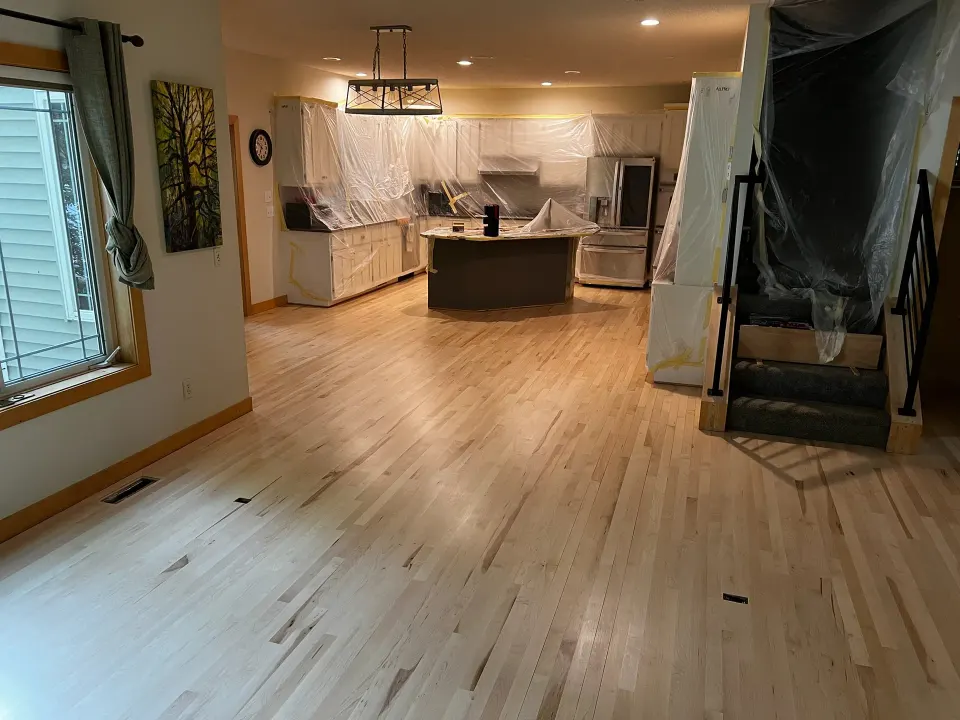
Part of hardwood floor refinishing: sanding, stain, finish and repair for floors that are already down.
Cupping, crowning and buckling, and what each one tells us
Cupping is the first sign of water from below or from a spill that sat. The edges of each board rise and the center dips, so the floor feels like a washboard underfoot. It means the bottom of the boards is wetter than the top, and it often flattens on its own once the moisture evens out. Crowning is the opposite shape, the center of each board higher than the edges, and it usually means a cupped floor was sanded flat before it finished drying and then dried the rest of the way. That one does not fix itself. Buckling is boards lifting clear off the subfloor, sometimes several inches, from a large amount of water fast, like a burst pipe or a failed water heater. Buckled boards have broken their fastening and come out. Dark staining along the joints tells us water has been there a while, and a musty smell tells us the subfloor is involved.
Drying the floor before anyone decides anything
We take moisture readings in the damaged area and in a dry room far from it, and the dry room sets the target. A cupped floor that is still reading high has not finished moving. Fans and dehumidifiers, usually run by a water mitigation company your insurer sends, pull the moisture out over days to weeks depending on how much water there was and how long it sat. We check the subfloor too, because a plywood or OSB subfloor that has swelled stays swelled and telegraphs through anything laid over it. During this stretch we photograph and document for the adjuster. A fair number of cupped floors we are called about flatten to the point where a light sand and recoat is all they need, and the only way to find out is to let them dry. The ones that do not flatten tell us which boards have to come out.
When boards have to come out
Boards that buckled have torn loose from their fasteners and do not go back down. Boards that stayed cupped after the readings came back to normal have taken a permanent set. Engineered planks that got wet enough for the core to swell or the veneer to lift are done, because the layers do not rebond. Black staining that goes through the board, splits along the grain and any sign of mold on the underside all mean replacement. We cut the affected boards out, check the subfloor for soft spots and flatness, replace or sister what is damaged, and let the new subfloor dry before any new flooring goes on it. New boards get laced into the field with staggered ends and matched for species, width and grade. Solid boards acclimate in the house before install so they are not swelling or shrinking against the old floor a month later.
When a refinish follows the repair
Two things decide whether the repair ends with a spot finish or a full sand of the room. The first is residual cupping. A floor that has dried and mostly flattened can be sanded flat once the moisture readings match the rest of the house, which takes off the small ridges that remain and gives a clean surface for finish. The second is color. New boards next to a floor that has aged ten years read lighter, and new finish next to old reflects differently. A kitchen repair of a few boards by the dishwasher can be spot finished and lived with. A repair of a third of the room is sanded and refinished edge to edge so there is no line. We also recommend a full refinish when the water left a gray tide line in the finish, since that is in the top coat and only a sand removes it.
What drives the cost of water damage repair on a hardwood floor
The size of the wet area and how long the water sat set most of it. A quick spill caught the same day may only need drying and a recoat. A slow leak under a dishwasher that ran for months has usually reached the subfloor, and subfloor work adds a trade and time. Board count is the next factor, along with whether the species and width are stocked or need ordering, and solid versus engineered, since engineered damage usually means more boards. A spot finish costs less than sanding and refinishing the room, and the repair size and location decide which you need. Drying time itself is not our charge but it sets the schedule. Insurance work needs documentation and sometimes a second visit for the adjuster, which we include. We give an itemized estimate once the floor has dried enough to show what is permanent.
When we would talk you out of it
- The floor is still reading wet on a meter. We will look and tell you what we see, and nobody should sand or replace boards until the readings match the dry parts of the house.
- Engineered flooring with a swelled or delaminated core. The boards do not recover and the fix is replacement, not repair.
- A whole-floor flood where the subfloor has gone soft. The subfloor is another trade's job first, and we come in after it is solid and dry.
What you get
- Moisture readings before any decision, so nothing is sanded wet
- Cupping that flattens on its own gets a recoat, not a tear-out
- Only the boards that failed come out, laced in to match
- Subfloor checked for swelling and soft spots
- Documentation for your insurance adjuster
- Full refinish only when the repair needs it to disappear
How the job runs
- 1
First look and readings
We take moisture readings in the wet area and a dry room, photograph the damage, and tell you what the shape of the boards says about the water.
- 2
Dry and recheck
Fans and dehumidifiers run until the readings match the dry room. We come back and see what flattened and what did not.
- 3
Replace what failed
Buckled, permanently cupped, split or delaminated boards come out. Subfloor checked and repaired. New boards acclimated and laced in.
- 4
Flatten and finish
Light sand to take out residual cupping, then a spot finish or a full refinish of the room depending on size and visibility.
Questions we get on the first call
My floor is cupping after a leak. Will it go back down?
Often, yes, if the water is stopped and the floor is dried properly. Cupping means the bottom of the boards is wetter than the top, and as the moisture evens out the boards relax. It can take weeks. What you should not do is sand it flat while it is still wet, because it crowns when it finishes drying. We take readings and set a date to look again.
How long does a water-damaged floor need to dry?
Days for a spill caught quickly, weeks for a leak that soaked the subfloor, and we go by moisture readings rather than the calendar. The target is the reading in a dry room on the other side of the house. Mitigation fans and dehumidifiers speed it up. Starting repairs before the readings match is how a floor gets fixed twice.
Do I have to replace the whole floor after water damage?
Usually not. Most leaks hit one area, and only the boards that buckled, stayed cupped after drying, split or delaminated come out. The rest of the floor stays. Whether the room then gets a spot finish or a full sand depends on how big the repair is and how visible. A whole-floor replacement is for floods that soaked everything and the subfloor with it.
Can you sand a cupped floor flat?
Yes, after it has dried, and not before. Once the moisture readings match the rest of the house, the small ridges that remain sand out and the floor gets refinished. Sanding while the boards are still wet takes the high edges off, and then the centers rise as the boards dry and you have a crowned floor that needs sanding again.
Will the repaired area match the rest of the kitchen?
If a few boards come out, we match species, width and grade and spot finish, and the repair shows a little until the new wood ages. If more than a small patch comes out, or the repair is in the open, we sand and refinish the room edge to edge so the color and sheen are one. We tell you which it will be before we start.
Related hardwood services
Where we do this work
Water damage repair across the west metro: Orono, Chanhassen, Cokato, Buffalo, Wayzata, Minnetonka, Excelsior, Edina, Eden Prairie and the lake towns between them. See everywhere we work.