
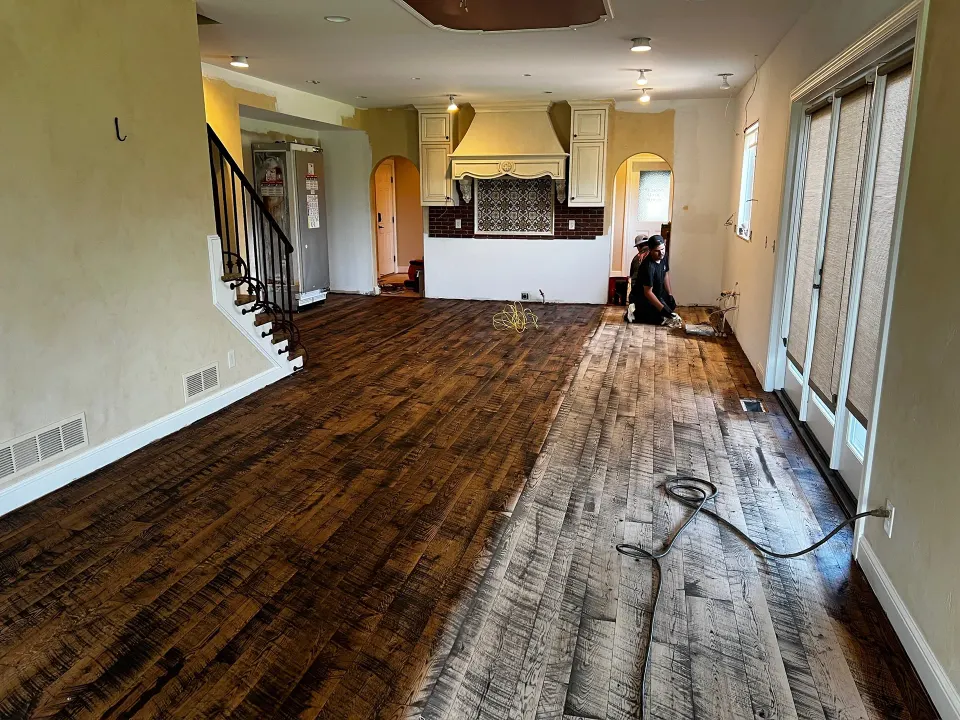
Part of hardwood floor refinishing: sanding, stain, finish and repair for floors that are already down.
Matching new flooring to the floor you already have
The most common request is an addition or a remodel where new hardwood meets original. The old floor has aged. Oil-based finish ambers over the years, sunlight shifts the color, and the species itself darkens, so matching the color on the sample card the original installer used gets you nowhere. The cleanest match is to sand the old and new floors together and stain them as one, which is what we recommend whenever the old floor can take a sand. When it cannot, we match the aged color on the new boards with a custom blend, test it against the existing floor in the same light, and tell you plainly how close it will read at the threshold. Species and grade have to match first. New white oak next to old red oak will never read right, no matter the stain.
Sample boards and test patches in your light
We bring sample boards of your species and we also stain test patches directly on your floor once it is sanded, because your boards and a sample from a different log take color differently. We usually mix three to five blends and lay them side by side so you can compare rather than judge one color on its own. Then we wait. A color that looks right under the shop lights at noon can go green under the warm LED cans in your kitchen at night, and south-facing glass on a Lake Minnetonka lot throws a different light again. We ask you to look in the morning and again in the evening. Once you pick, we record the exact blend, ratios and application method so the floor stays consistent from the first board to the last and we can repeat it for a repair years later.
Maple, red oak and white oak take stain differently
The species is the limit on what a stain can do. Hard maple is dense and closed, so pigment stains sit unevenly and blotch, and the darker the color the worse it gets. We tell maple owners that plainly and steer toward natural or a light tone. Red oak has a pink undertone that fights cool colors, so gray and greige stains on red oak turn mauve unless the blend is built to counter it. White oak is the easy one. It takes stain evenly, has no pink, and goes from pale Scandinavian to near black without drama, which is part of why the new builds on the lake are mostly white oak. Hickory varies board to board between light sapwood and dark heartwood, and stain widens that contrast rather than hiding it. We would rather show you a sample on your own species than promise a picture from a magazine.
How the finish changes the stain color
The clear coat on top is part of the color. Water-based polyurethane dries clear and keeps the stain true, which is what you want for light, gray or cool colors. Oil-based polyurethane adds amber when it goes on and keeps ambering for years, which warms a medium brown nicely and ruins a pale white oak floor over time. Hardwax oil carries its own pigment and sits in the wood rather than on it, so the color is softer and more matte, and small areas can be touched up later without redoing the room. Sheen shifts the read too, since gloss deepens a dark stain and satin softens it. When we stain a test patch we put the actual finish over it before you decide, because stain without finish on it is a different color from the floor you will live on.
What drives the cost of custom stain work in the Twin Cities
Stain is usually one line inside a refinish or install estimate, and the color work changes it in a few ways. A natural finish skips the stain day entirely. A standard single-color stain adds a step and dry time. A custom match adds sampling time, more than one round of test patches, and sometimes a water-pop or a conditioner so the color goes on evenly, which matters most on maple and on dark colors. Matching an existing aged floor takes longer than picking a new color because we are chasing a target. Two-tone work, such as a border in a different color, is hand work and priced that way. A standalone color consultation with sample boards, with no floor work booked, is its own small line.
When we would talk you out of it
- A dark, even espresso on hard maple. We can get close with a dye and a lot of care, and we would still rather show you a natural or light-tone sample first.
- An exact match to a factory prefinished floor with a site-applied stain. The factory color is layered under a wear coat, and the closest site match still reads a shade off. We will tell you how close before you commit.
- A gray stain on red oak. The pink undertone fights the gray, so the floor reads mauve. White oak takes gray cleanly, and red oak needs a different plan.
What you get
- Test patches on your own sanded floor, in your own light
- Several blends side by side, not one color in isolation
- Formula recorded for consistency and future repairs
- Plain advice by species before you fall for a photo
- Finish applied over the sample so you see the real color
- Matching for additions, repairs and board replacement
How the job runs
- 1
Color conversation
Inspiration photos, the cabinets and trim the floor has to live with, and the species you have. We say early if the species will not do what the photo shows.
- 2
Sample blends
We mix several blends and apply them to sample boards of your species, then to test patches on your sanded floor.
- 3
Look twice
You view the patches in morning and evening light with the finish over them. We adjust and re-test if needed.
- 4
Approval and record
You sign off on one patch. We record the blend and method and stain the floor to match it, start to finish.
Questions we get on the first call
Can you match the new hardwood to the floor we already have?
Yes, with two caveats. The species and grade must match first, since no stain makes red oak look like white oak, and the closest match comes from sanding old and new together and staining them as one, which we recommend whenever the old floor can take it. Matching new boards to an aged floor without sanding it gets close, and the line at the threshold may still show faintly until the new wood ages.
Why does the stain look different on my floor than on the sample card?
Because the card is printed on paper or on a different species, and stain is not paint. The color comes from pigment sitting in the grain of your specific wood, so species, cut, how fine the floor was sanded and the finish on top all change it. The only reliable sample is a test patch on your own sanded floor with the real finish over it, which is what we do.
Can you stain maple dark?
We can get it darker, and we will tell you up front that it will not be even. Hard maple is dense and closed-grained, so pigment stains blotch, and dark colors show the blotching most. Dyes and a careful conditioning step get closer than a stain off the shelf. Our advice is a natural or light finish on maple, and a dark floor on white oak if dark is the goal.
Do I have to pick the color before you start sanding?
No, and we would rather you did not. The true test patch can only be done on sanded wood, so we sand first, lay the blends on your floor, and you choose with the real surface in front of you. It helps to have narrowed it to a direction, light or dark, warm or cool, before we arrive, so the first round of blends is close.
Related hardwood services
Where we do this work
Stain color matching across the west metro: Wayzata, Minnetonka, Edina, Eden Prairie, Chanhassen, Plymouth, Maple Grove, Minneapolis, Orono and the lake towns between them. See everywhere we work.