
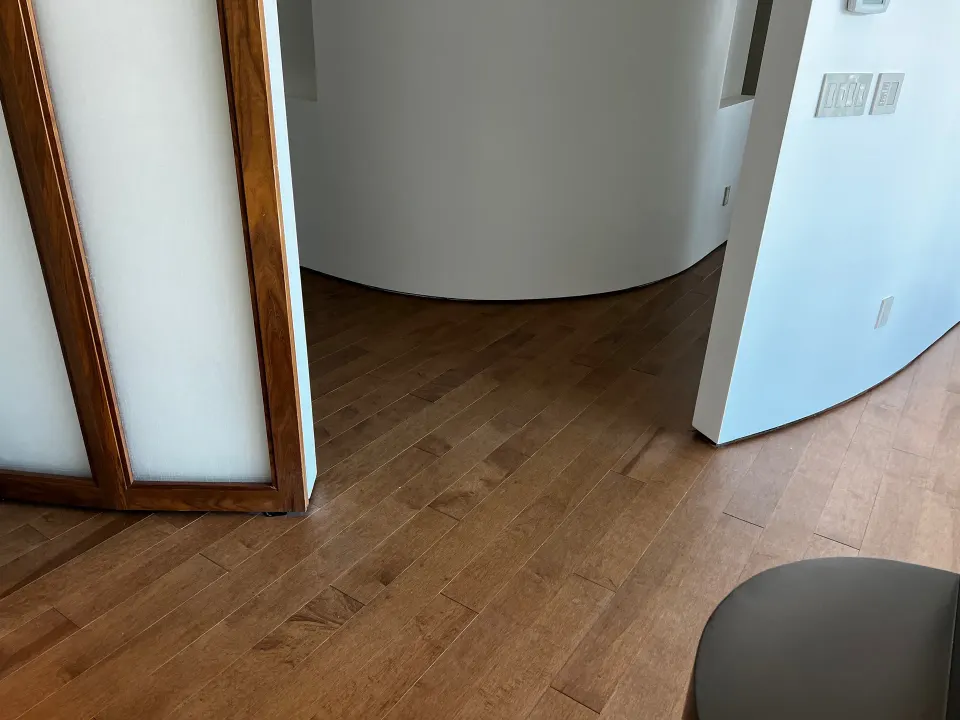
Part of hardwood floor refinishing: sanding, stain, finish and repair for floors that are already down.
Scratch and dent repair
The first question is whether the scratch is in the finish or in the wood. Finish scratches, the kind from chair legs and dog nails, look white or gray and disappear when you wet them. Those get fixed with a screen and recoat of the room. Scratches into the wood and dents from a dropped pan need the spot sanded to bare wood, the color rebuilt and the finish feathered into the surrounding floor. Shallow dents on bare wood can sometimes be steamed up before sanding. The hard part of a spot repair is sheen, since new finish next to old finish reflects light differently until it ages, so we feather wide and often recoat the whole room so the sheen matches wall to wall. A spot repair along a wall or under furniture hides well. One in the middle of a sunlit room shows for a while, and we will tell you that up front.
Gaps between boards
Gaps in a Minnesota hardwood floor are usually the season, not a defect. Forced-air heat pulls the house below 25% humidity in January, the boards shrink, and gaps open along the whole floor. By July they have closed. Filling those in winter fails, because the filler gets squeezed out or crushed when the boards swell, so our first advice on a seasonal gap is a humidifier on the furnace and patience. Gaps that stay open through August are a different problem. Those come from a floor that was installed too wet and shrank for good, from a leak that swelled and then dried the boards, or from a subfloor that has moved. Small permanent gaps get a flexible filler that matches the floor. Wider ones get a wood spline glued in and sanded flush. A floor with wide permanent gaps throughout is usually better relaid than filled, and that is a replacement conversation.
Pet damage and urine stains
Nail scratches from a dog are almost always in the finish, and a recoat of the room takes care of them. Urine is the harder problem. It soaks into the wood, reacts with the tannin in oak and turns the boards black, and by the time it shows it has gone deeper than a sand can safely chase. Light stains lighten under sanding and disappear under a medium or dark stain color. Black stains do not. The options there are a two-part wood bleach, which lightens the stain but can leave a pale halo, or cutting out the affected boards and lacing in new ones, which is the cleaner fix. We will tell you which we recommend after seeing how deep the stain goes once the finish is off. If the whole room smells, the subfloor has absorbed it too and needs sealing before the new boards go down.
Board replacement
Some damage cannot be sanded or filled. Split boards, boards that have cupped or delaminated after a leak, deep gouges, black urine stains and old patches in the wrong species all come out. We cut the damaged boards out along their length, remove them without disturbing the neighbors, and lace new boards into the field with staggered ends so there is no square outline. Species, width, grade and cut all have to match the existing floor. New wood is lighter than a floor that has aged, so a replacement in an older floor either gets stained to match or the whole room gets sanded and refinished together, which is what we recommend when the repair is in plain view. On a prefinished floor, replacement boards from the same product line drop in with a close match, which is why it pays to keep the leftover bundle from an install.
What drives the cost of hardwood floor repair in the west metro
Repairs are priced by what the damage needs rather than by the square foot. A recoat of a room to clear finish scratches is the simplest and is priced like a buff and coat. A spot sand and refinish of one area adds color matching and feathering time. Board replacement depends on how many boards, whether the species and width are stocked or have to be ordered, and whether the floor is nailed, glued or prefinished, since each comes out differently. Matching stain on an aged floor takes sampling time. If the repair sits in the open and the room needs a full sand to hide it, that becomes a refinish quote for the room. Small repairs in Wright County are easy to schedule between larger jobs because the drive from Cokato is short. We quote from photos when we can and confirm in person before work starts.
When we would talk you out of it
- Damage in a dozen places across the floor. At that point a full sand and refinish costs less per fix and looks better than a field of patches.
- A patch in the middle of a sunlit room that you expect to vanish. We can get close, and the new wood and sheen still read faintly until they age. We would rather refinish the room.
- Water damage that is still wet. Cupped boards need to dry, sometimes for weeks, before anyone can tell which ones need replacing.
What you get
- Fix the spot instead of refinishing the house
- Species, width and grade matched before we cut anything
- New boards laced in, never a square patch
- Color matched to the aged floor, not to a sample card
- Honest call when a repair will show
- Quick scheduling on small jobs in Wright County
How the job runs
- 1
Look and diagnose
Photos first, then in person if needed. We sort finish damage from wood damage and tell you whether it is a recoat, a spot repair or board replacement.
- 2
Match materials
Species, width, grade and cut matched to your floor, stain blended to the aged color, finish type and sheen identified.
- 3
Repair
Spot sand, fill, spline or cut out and lace in new boards, then sand the repair flush with the surrounding floor.
- 4
Blend and finish
Stain and finish feathered into the field, or the whole room recoated so the sheen is one. Care notes on cure time.
Questions we get on the first call
Can you fix a few scratches without redoing the whole floor?
Yes. If the scratches are in the finish, which is most of them, a screen and recoat of that room clears them in a day without sanding to wood. If a few are into the wood, we spot sand those, rebuild the color and feather the finish, usually recoating the room so the sheen matches. Neither one means refinishing the house.
Will the repaired boards match the rest of my floor?
Along a wall or under furniture, you will have to look for it. In the middle of a bright room, a repair shows faintly for a while because new wood is lighter than aged wood and new finish reflects differently, and the gap closes over a year or two. When the spot is in plain view we usually recommend sanding and refinishing the whole room with the repair so everything matches from day one.
Can pet stains be sanded out?
Light ones, yes. Black ones, usually not. Urine reacts with the tannin in oak and the stain goes deeper than a safe sand can reach. Once the finish is off we can see how deep it is and then recommend either a two-part bleach, which lightens it with some risk of a pale spot, or replacing the stained boards, which is the cleaner result.
Why do gaps open in my floor every winter?
Because the furnace dries the house out. Indoor humidity in a Minnesota house on forced-air heat drops under 25% in January, the boards give up moisture and shrink, and gaps open across the floor. They close again in summer. That is normal for solid wood and not something to fill. A humidifier on the furnace narrows the swing. Gaps that stay open in August are the ones we repair.
Do you repair prefinished floors?
Yes. Prefinished boards come out and go back in the same way as site-finished ones, and if you kept the leftover bundle from the install the match is close. Without leftovers we source the same product when it is still made, or the nearest match. Prefinished floors cannot be spot sanded and refinished to match, so board replacement is the usual fix for damage into the wood.
Related hardwood services
Where we do this work
Floor repair across the west metro: Minnetonka, Excelsior, Edina, Plymouth, Minneapolis, Cokato, Buffalo, Wayzata, Orono and the lake towns between them. See everywhere we work.