
Whole-house projects and how we sequence them
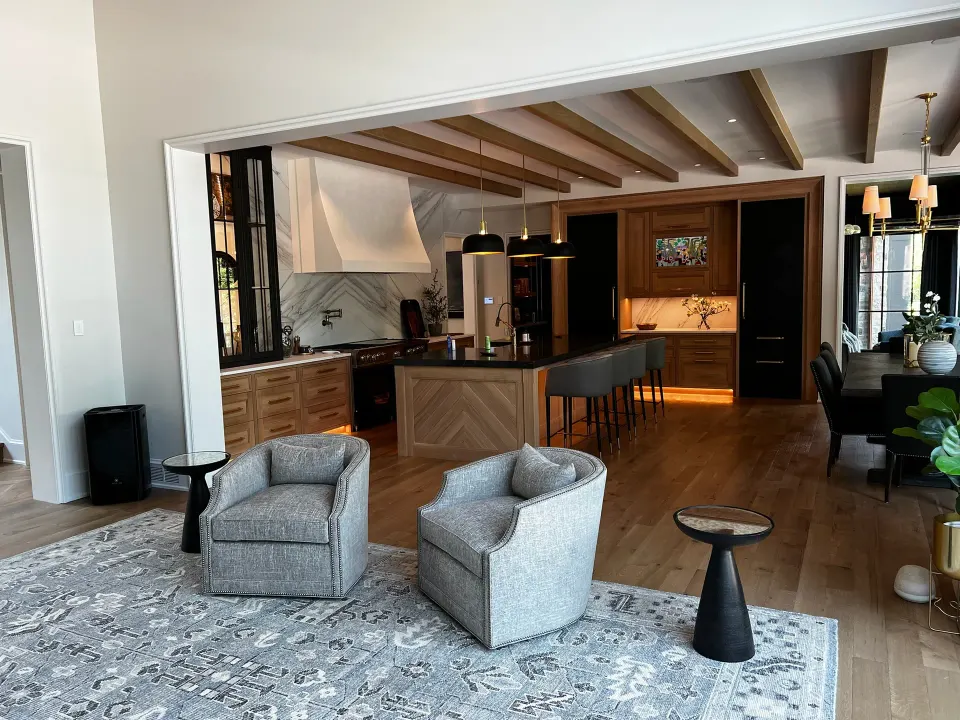
A whole-house job, whether it is new hardwood through the main floor or a full refinish of an older house, is a sequencing exercise. We start by walking every room and deciding where the floor runs continuous and where it breaks at a doorway, because that decides whether the house can be split into phases or has to go all at once. In a 1990s Plymouth two-story with hardwood in the kitchen and family room and carpet upstairs, the main floor is one continuous pour of finish and the stairs and upstairs can follow. In a 1920s Edina house with original red oak everywhere, the halls connect every room and the practical answer is one pass with the family out for the finishing days. Either way you get a day-by-day schedule before we start, and the number of days we quote is the number we plan to be there.
Working in a home you are living in
Most of our residential work happens with people in the house. Sanding is the messy part, so we run dust containment on the sanders and seal off the rooms we are working in from the rest of the house. Furniture gets moved out of the working rooms and back in once the finish has cured, and we tell you which day that is. Finish fumes depend on the product: water-based finishes are low odor and dry fast enough to walk on in socks the same evening, oil-based ambers nicely but smells for days and cures slower, and we will talk you toward water-based if anyone in the house is sensitive. Pets and bare floors do not mix during finishing, so the dog spends those nights elsewhere. You keep a working path to the bedrooms and a bathroom through the job, and we schedule the kitchen last so it is out of service for the shortest stretch.
Phasing rooms without a visible line between them
Doing the house in stages is common and works, with two rules. First, wherever new floor meets old or this year's room meets last year's, the boards are laced together rather than butted with a transition strip, so the joint disappears into the pattern of end joints. Second, the color has to be matched, not approximated. Hardwood shifts color with age and sun, so a stain that was right three years ago needs to be re-mixed against the floor as it is now, on a sample board, in the room's daylight. On a prefinished floor we keep a record of the product and lot so a later room can be ordered to match. When a whole floor will eventually be refinished, we sometimes recommend installing the new room unfinished and sanding both together later, which is the only way to get a perfect match across the line.
What drives the cost of residential hardwood flooring in the west metro
The type of work comes first. A buff and coat costs a fraction of a full refinish, which costs less than a new install, which costs less than a new install with tear-out of tile. Within an install, species, width, solid or engineered and prefinished or site-finished set the material and labor lines. Within a refinish, the floor's condition decides how much sanding and repair it needs, and a stain color change adds a step. Square footage counts, but so does the room layout, since closets and doorways slow everything down. Phasing a house over several visits costs more than doing it at once because of setup and matching time. Stairs and repairs add time, and so does working around an occupied kitchen or moving heavy furniture, and each shows up as its own line on the estimate.
When we would talk you out of it
- A house you are about to sell where the floors are merely dull. A buff and coat or a good cleaning gets a floor ready for photos; a full refinish rarely pays back at closing and we will tell you which one you need.
- A floor that needs a repair, not a project. A few boards near the back door or a pet stain in one room is a repair visit. We will not scope a whole-house refinish around a problem the size of a doormat.
- A bathroom, laundry or a basement with moisture history. Hardwood belongs in the rest of the house. Those rooms do better in tile, and we will say so rather than install something that fails.
What you get
- Installation, refinishing, repair, stain matching and stairs from one company
- Dust-controlled sanding and rooms sealed off from the rest of the house
- A day-by-day schedule before the first day, including the furniture return date
- Phased projects with the rooms laced together and the color re-matched
- Water-based, oil-based and hardwax oil finishes explained in plain terms
- About 150 projects a year across the west metro and Wright County since 2007
How the job runs
- 1
Walk the house
We look at every room, the subfloor and the existing floor, and talk through what you want and which rooms need to stay usable.
- 2
Plan the phases
You get a written estimate with each room and task itemized, and a day-by-day schedule that fits the household.
- 3
Do the work
Tear-out, install or sanding, stain and finish, with containment up and a path to the bedrooms kept open.
- 4
Cure and move back in
Furniture returns on the day we told you, we walk the floor with you and leave care instructions.
Questions we get on the first call
Can we stay in the house while you do the floors?
In most cases, yes. Installation and sanding are noisy but livable from another part of the house. The finishing days are the hard ones, because the coated rooms are off limits until they dry and the smell of an oil-based finish lingers. Many families stay through an install and leave for one or two nights of finishing.
Should we do the whole house at once or one room at a time?
Once, if the budget and the household can take it, because the color matches perfectly and the setup happens one time. If the rooms are divided by doorways and the budget is spread out, phasing works fine as long as the boards are laced together at the joint and the stain is re-matched against the aged floor each time.
How do we get our furniture out of the way?
Small things and breakables go in boxes before we arrive. We move the couches, tables and beds into rooms we are not working in, or into a garage, and bring them back once the finish has cured. Pianos, aquariums and large appliances need a plan of their own, and we will talk about them on the walk-through.
How long before we can walk on the new floor?
With a water-based finish, socks the same evening and shoes the next day. Furniture and rugs wait until the finish has cured, which for most water-based systems is several days and for oil-based is longer. We put the exact dates on the schedule, and the rug date is the one people forget, so we say it twice.
Related hardwood services
Where we do this work
Residential Flooring across the west metro: Wayzata, Orono, Minnetonka, Excelsior, Edina, Eden Prairie, Chanhassen, Plymouth, Maple Grove and the lake towns between them. See everywhere we work.