
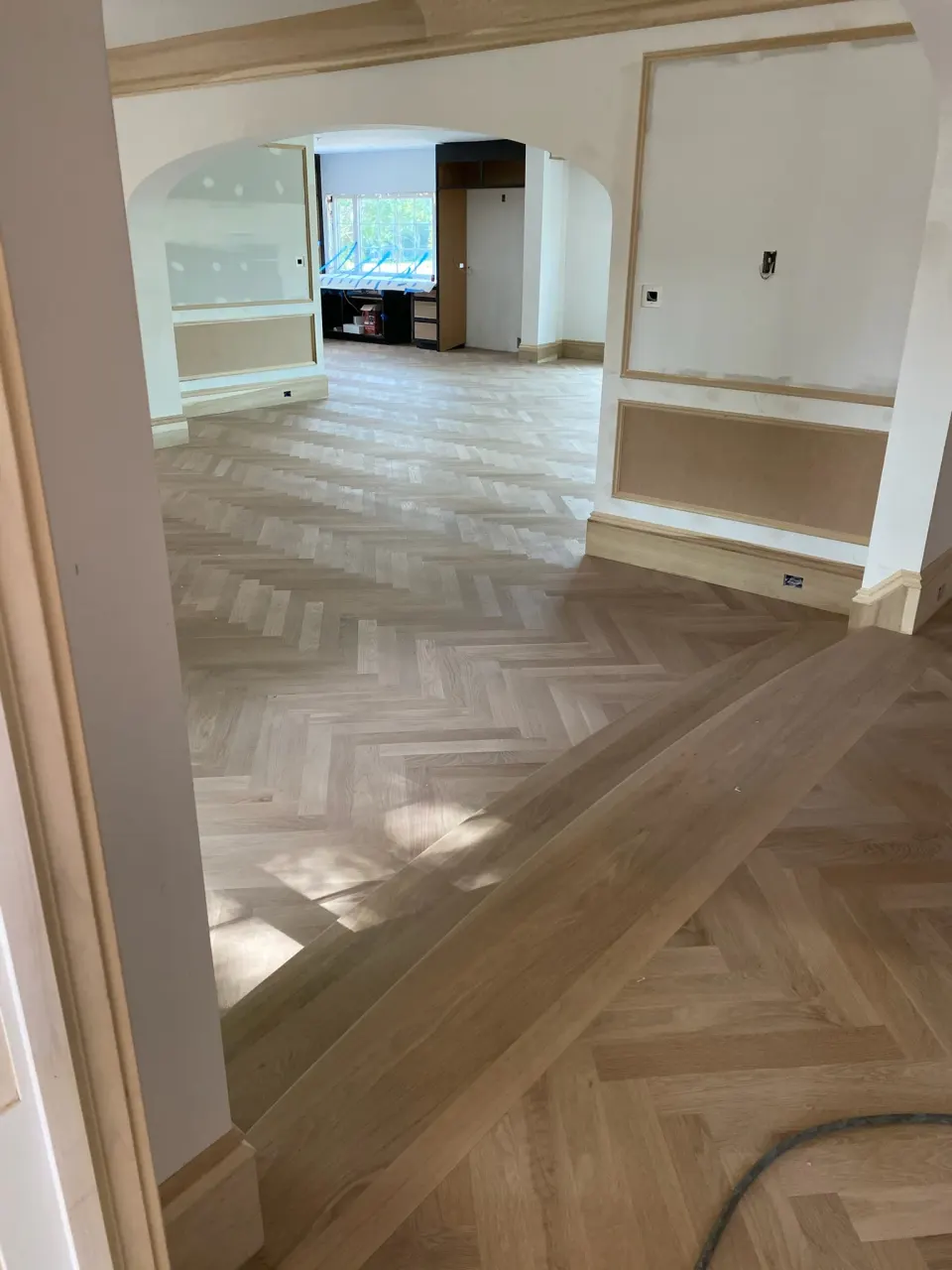
Herringbone, chevron and parquet, and how to tell them apart
Herringbone uses rectangular boards with square ends, laid so each board butts into the side of the next at 90 degrees. The result is a staggered zigzag, and because the pieces are plain rectangles it is the most forgiving of the three. Chevron uses boards cut at an angle on the ends, usually 45 degrees, so the two directions meet in a continuous point and the pattern reads as a run of arrows. It is the cleaner line and the less forgiving install, because every point has to land. Parquet covers the block and basket-weave patterns, where short pieces form repeating squares, as well as the large-format geometric floors you see in older halls. We install herringbone and chevron in widths from two and a quarter inches up to five or six inch planks, and the width changes the feel more than people expect. A narrow herringbone reads traditional; a wide one in white oak reads modern.
Borders, medallions and where the pattern stops
A pattern floor needs an edge. Running herringbone straight into the wall leaves a row of sawtooth cuts under the base, which works in a modern room but looks unfinished in most. The usual answer is a border: one or two straight boards framing the room, sometimes with a contrasting strip of walnut between them, with the pattern fitted to the inside. In a hallway the border also solves the doorway problem, because the pattern can stop cleanly at the frame instead of running through it at an angle. Medallions, either made from the same species or a contrasting one, go into entries and under chandeliers; they are set first and the pattern is scribed to them. In an open plan we help you decide where the pattern ends and the plank begins, which is usually at a cased opening or a line that the ceiling or the cabinets already draw.
Full-scale layout before the first board
Plank forgives a wall that is a half inch out of square. Pattern does not. So before anything is nailed we find the center of the room, or the sightline the room is organized around, and snap the pattern's centerline on the subfloor. From there we lay out the full pattern on paper or in chalk, work the repeat out to each wall and see where the cuts land. If a border is going in, we size it so the pattern inside it finishes in whole or half pieces along the long walls instead of slivers. Doorways, the fireplace hearth and the stair nosing all get checked against the layout. On a chevron the layout also sets the spine, the straight line where the points meet, and that line has to stay dead straight the length of the room. The layout takes an hour or two, and we do not skip it.
Why a pattern floor takes longer than plank
Expect a pattern floor to take two to three times the install days of the same square footage in plank, and plan the budget and the schedule for that. Every board in a herringbone is handled, placed and fastened individually, and every row is checked against the chalk line because a small drift compounds across the room. Chevron adds an angled cut on every end. Borders are fitted piece by piece and the pattern is scribed into them. Sanding a pattern floor is slower too, because the grain runs in two directions and the sander has to cross both without leaving marks; the final passes are done at an angle to the pattern, not with it. Material waste runs higher than plank because of the cuts at the edges. We say all of this up front so the budget and the calendar are set for it before anyone falls for a sample board.
What drives the cost of a herringbone or chevron floor in the Twin Cities
Labor per square foot is the main difference from plank. A pattern floor takes more install days for the same area, chevron more than herringbone, and sanding and finishing take longer because the grain runs two ways. Material cost rises with species and width and with the pattern itself, since herringbone and chevron stock is cut to length and often sold at a premium, and waste at the edges runs higher. Borders and medallions are each their own line, priced by the linear foot or the piece. The room matters: a rectangular dining room with four walls is quick to lay out, while an open plan with a hearth and six doorways is not. Subfloor flatness is non-negotiable under a pattern, so any grinding or leveling shows up before the install line. We itemize each so you can see what the pattern is costing over plank.
When we would talk you out of it
- A whole house on a plank budget. The pattern costs real money per square foot. If the budget is fixed, put herringbone in the entry or the dining room and run matching plank through the rest; the contrast makes the pattern read better anyway.
- A subfloor that cannot be made flat. Pattern floors telegraph every hump and dip, and if the deck cannot be flattened within tolerance the floor will show it in the raking light from a window. We check that before we price it.
- A room where you want the floor to disappear. Pattern is a design decision that competes with furniture and rugs. If the room is already busy, a wide plank in the same species is the calmer floor.
What you get
- Herringbone, chevron and parquet in solid or engineered stock
- Borders, feature strips and medallions fitted to the pattern
- Full-scale chalk layout and sizing of the border before any cutting
- Sanding done across both grain directions so the finish reads flat
- Pattern in one room laced into plank in the next
- Installed in new builds, remodels, retail spaces and halls across the area
How the job runs
- 1
Pick the pattern and the width
We bring planks and pattern samples, talk through herringbone versus chevron, width, species and whether a border fits the room.
- 2
Prep the subfloor and lay it out
The deck is flattened, the centerline is snapped and the full pattern and border are laid out in chalk before a board is cut.
- 3
Set the pattern
Medallions and borders go in first where they apply, then the field is installed row by row against the chalk line.
- 4
Sand, stain and finish
The floor is sanded across both grain directions with dust containment, stained if selected and coated.
Questions we get on the first call
What is the difference between herringbone and chevron?
Herringbone boards have square ends and meet in a staggered zigzag, each board butting into the side of the next. Chevron boards are cut at an angle on the ends so they meet point to point in a continuous arrow line. Chevron reads cleaner and more modern; herringbone is the more traditional and more forgiving pattern to install.
How much longer does a herringbone floor take to install?
Plan on two to three times the install days of the same square footage in plank, plus longer sanding days because the grain runs two ways. A dining room that would take a day in plank is often two or three in herringbone. Chevron runs longer than herringbone because of the angled cuts.
Can I do herringbone in just the entry and plank everywhere else?
Yes, and that is the version we recommend most. Herringbone in the entry or dining room with matching plank through the rest of the house puts the money where it is seen. The pattern stops at a border or a cased opening and the plank picks up from there, in the same species and finished together so the color matches.
Does a pattern floor need a border?
Usually. Without one, the pattern runs into the wall as a row of angled cuts hidden under the base, which can work in a modern room but looks unfinished in most. A single or double board border frames the pattern, solves the doorways and lets the field finish in whole pieces. We lay out both options in chalk so you can see them.
Can you do herringbone in engineered hardwood over my radiant heat?
Yes. Several suppliers make engineered herringbone and chevron blocks with a white oak wear layer, prefinished or unfinished, and they glue down over a heated slab the same way plank does. The layout, the border and the slower install are the same as solid. The engineered core keeps the blocks stable over the heat.
Related hardwood services
Where we do this work
Pattern Floors across the west metro: Wayzata, Minneapolis, Orono, Minnetonka, Excelsior, Edina, Eden Prairie, Chanhassen, Plymouth and the lake towns between them. See everywhere we work.