
Alpine Hardwood · April 21, 2026 · Engineered Hardwood Install
Wide plank hardwood floors and the trade-offs nobody mentions
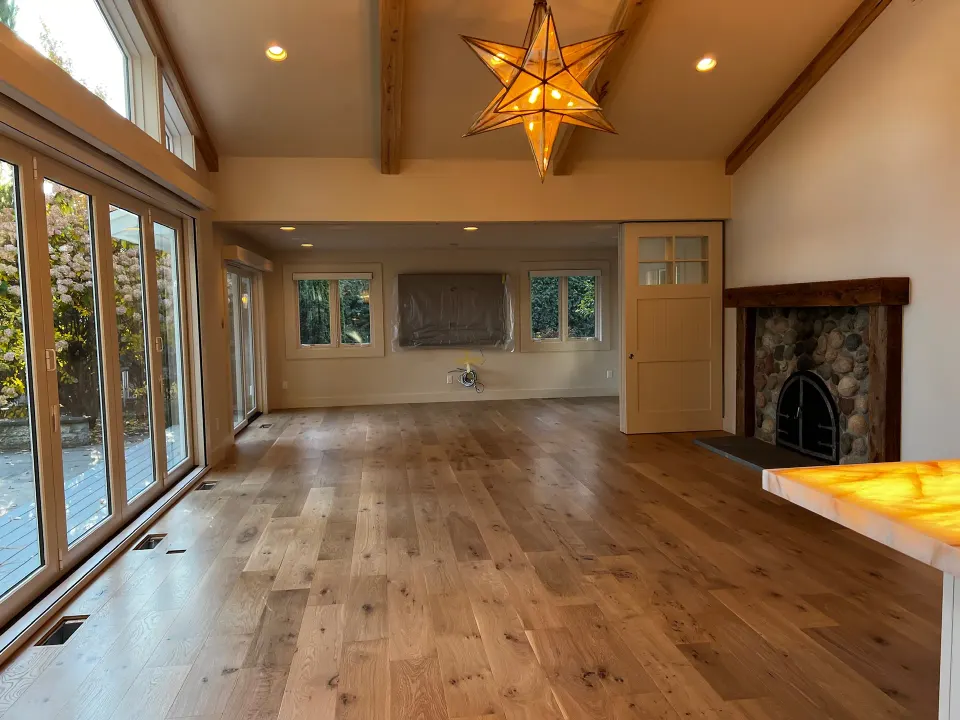
The short answer: Wide plank hardwood looks calmer and shows more of each board’s grain than narrow strip, and it performs well in a Minnesota house as long as the house holds its humidity through the winter and the subfloor is flat. For planks over six inches we recommend engineered construction in most homes, because solid boards that wide open noticeable gaps every January unless the house is humidified year-round.
Wide plank has been the biggest shift in residential hardwood over the last ten years. For decades a two and a quarter or three and a quarter inch board was the standard. Now we regularly install planks seven, eight and ten inches wide, especially in the new lake homes along the Highway 12 corridor. The look is excellent. The physics gets more complicated, and this post covers both.
Why wide planks look different
A wider plank shows more of each tree in one continuous piece. Long cathedral grain, knots, mineral streaks and the slow color shifts across a board all survive intact instead of being cut up into strips. Fewer seams mean less visual noise across the room, which is why a wide plank floor reads as calmer and more modern even when the species and stain match a strip floor next door.
It also reads as more substantial, which is a large part of its appeal in a great room with a vaulted ceiling and a wall of glass. The floor has to hold its own against the scale of the room, and a wide board does that in a way a narrow one does not. The downside of all that exposed grain is that defects have nowhere to hide. A cupped board or a winter gap on a ten inch plank is obvious from the doorway, and the same flaw on a strip floor would go unnoticed for years.
Movement is the real issue
Wood expands and contracts across its width, not along its length. A three inch board that shrinks one percent loses a hair over a thirty-second of an inch. An eight inch board shrinking the same one percent loses more than twice that, and because the gap appears at every seam, the floor as a whole shows it. Wide planks amplify every humidity swing the house goes through.
Minnesota winters are hard on this. Forced-air heat often pulls indoor humidity under 25 percent in January, and solid flooring responds by shrinking. Summer brings the moisture back and the boards swell. A narrow strip floor rides that cycle with gaps most people never notice. A wide plank floor in the same house, without a whole-house humidifier holding winter levels where the flooring manufacturer specifies, shows gaps every January that are hard to miss and that often close up again by July. Wood does that whether or not anyone wants it to, but it surprises people who were not told to expect it.
Acclimation matters more here too. We bring the flooring into the house ahead of installation and let it settle toward the home’s living conditions before it goes down. Installing wide plank in a house that still has wet drywall mud and no heat running is how floors end up cupped by spring, and we will push an install date back rather than put a floor into a building that is not ready for it.
Solid or engineered for wide plank
For planks over six inches we recommend engineered hardwood in most homes. Engineered flooring has a real hardwood wear layer bonded to a plywood or cross-laminated core, and the cross-grain construction resists seasonal movement far better than a solid board does. You get the same species, width and finish on the surface with a fraction of the seasonal gapping.
Engineered is also the default over in-floor radiant heat, in walkouts and basements, and on concrete slabs, which describes a lot of the new construction around Lake Minnetonka. Radiant heat dries the floor from below, and a solid wide plank on radiant is asking for trouble.
Solid wide plank can work, and it has one advantage engineered does not. A three quarter inch solid floor can be fully sanded three or four times over its life, while an engineered wear layer usually gets one. If the house is on a conventional wood subfloor, has a humidifier on the furnace and the owner plans to be there for decades, solid wide plank is a reasonable choice. Slab-on-grade, radiant heat or a house that sits empty and unheated for stretches of winter rules it out.
Subfloor flatness
Narrow strip forgives a lot. Wide plank does not. A subfloor that dips or heaves even slightly shows up as hollow spots, boards that rock under weight or seams that squeak. Before we lay wide plank we check the subfloor with a long straightedge and sand or fill anywhere it varies more than about an eighth of an inch over ten feet. On a new build that means coordinating with the framer, and on a remodel it often means a day of prep nobody budgeted for. That prep is frequently the biggest variable in a wide plank install, and skipping it is the most common reason a wide plank floor disappoints.
Glue-assist installs are more common with wide engineered plank for the same reason. A bead of adhesive under the board, along with the nails or staples, holds the plank tight to the subfloor and cuts down on movement and noise. It adds a step, and on a floor this unforgiving the step is worth it.
Typical widths in Twin Cities custom homes
In the custom homes we floor around the west metro, six and seven inch planks are the workhorses. They give the wide plank look, they are available in most species and grades, and they behave well in engineered construction. Eight inch is a step up in presence and asks a bit more of the house. Wider than eight is a statement choice, usually in rift and quartered white oak, and it needs the tightest conditions to stay stable. Ten inch and wider plank exists and looks the part in the right room. Before we order it, we sit down with the owner and the builder and walk through what it will do in January so nobody is surprised later.
Room size matters in that conversation. A ten inch plank in a 12 by 12 bedroom shows only a dozen boards across, which can look coarse. The same plank in a great room with a 30 foot run looks proportionate. We often suggest stepping down a width in smaller rooms and keeping the widest boards for the spaces that can carry them.
Species that suit wide plank
White oak is the most common wide plank species we install, and for good reason. It is hard (1,360 on the Janka scale), it takes stain evenly, and rift and quartered cuts of white oak are among the most dimensionally stable boards available, which matters more as the plank gets wider. The pale, even color also suits the light, matte finishes most people want on wide plank right now.
Hickory is harder still at 1,820 and shows strong color variation between sapwood and heartwood, which can be dramatic in a wide board. Some owners love it in a cabin or a lake house with a rustic direction. Others find it busy. Black walnut is softer at 1,010 and dents more easily, so it belongs in a formal room or a bedroom rather than a mudroom. Hard maple is tough but blotches under dark stain, so wide maple plank is best left natural or lightly tinted. We keep sample boards and full planks of each at the shop in Cokato so the choice can be made in hand rather than from a photo.
Where wide plank makes sense and where it does not
Wide plank is a strong choice when the house supports it. That means a humidifier that runs all winter, a subfloor prepped flat, engineered construction in most rooms, and a width matched to the size of the space. On the large new homes along the north shore of Lake Minnetonka around Wayzata and Orono, where big glass walls and radiant floors are common, that combination is standard and the floors perform. If humidity control is not in the plan, or the budget does not cover subfloor prep, a narrower board will look better in February than a wide one will. We would rather say that up front than come back to a floor that is gapping. Every width we install gets the same prep and the same finish standard. The width only changes how much the house has to cooperate.
Want us to look at your floor?
Free estimate after a visit. We bring sample boards.
Questions we get on the first call
Will wide plank hardwood floors gap in the winter?
Solid wide plank almost always shows some gapping in a Minnesota winter, because forced-air heat drops indoor humidity hard and wood shrinks across its width. A whole-house humidifier keeps the gaps small. Engineered wide plank moves far less, which is the main reason we recommend it for boards over six inches.
What is considered wide plank hardwood flooring?
Anything five inches or wider is generally called wide plank, compared with the two and a quarter or three and a quarter inch strip that was standard for decades. In the custom homes we floor, six and seven inch planks are the most common, eight inch is a step up, and ten inch and wider is a statement choice.
Can I put wide plank hardwood over in-floor radiant heat?
Yes, with engineered construction. Radiant heat dries flooring from below and solid wide plank will gap and cup over it. Engineered wide plank with a cross-laminated core handles radiant well, and it is what we install on most of the new lake homes that run radiant on the main level or in a walkout.
Does wide plank flooring need a special subfloor?
It needs a flat one. Wide boards bridge low spots instead of following them, which leaves hollow spots and boards that rock. We check the subfloor with a long straightedge and sand or fill anywhere it varies more than about an eighth of an inch over ten feet before the first plank goes down.