
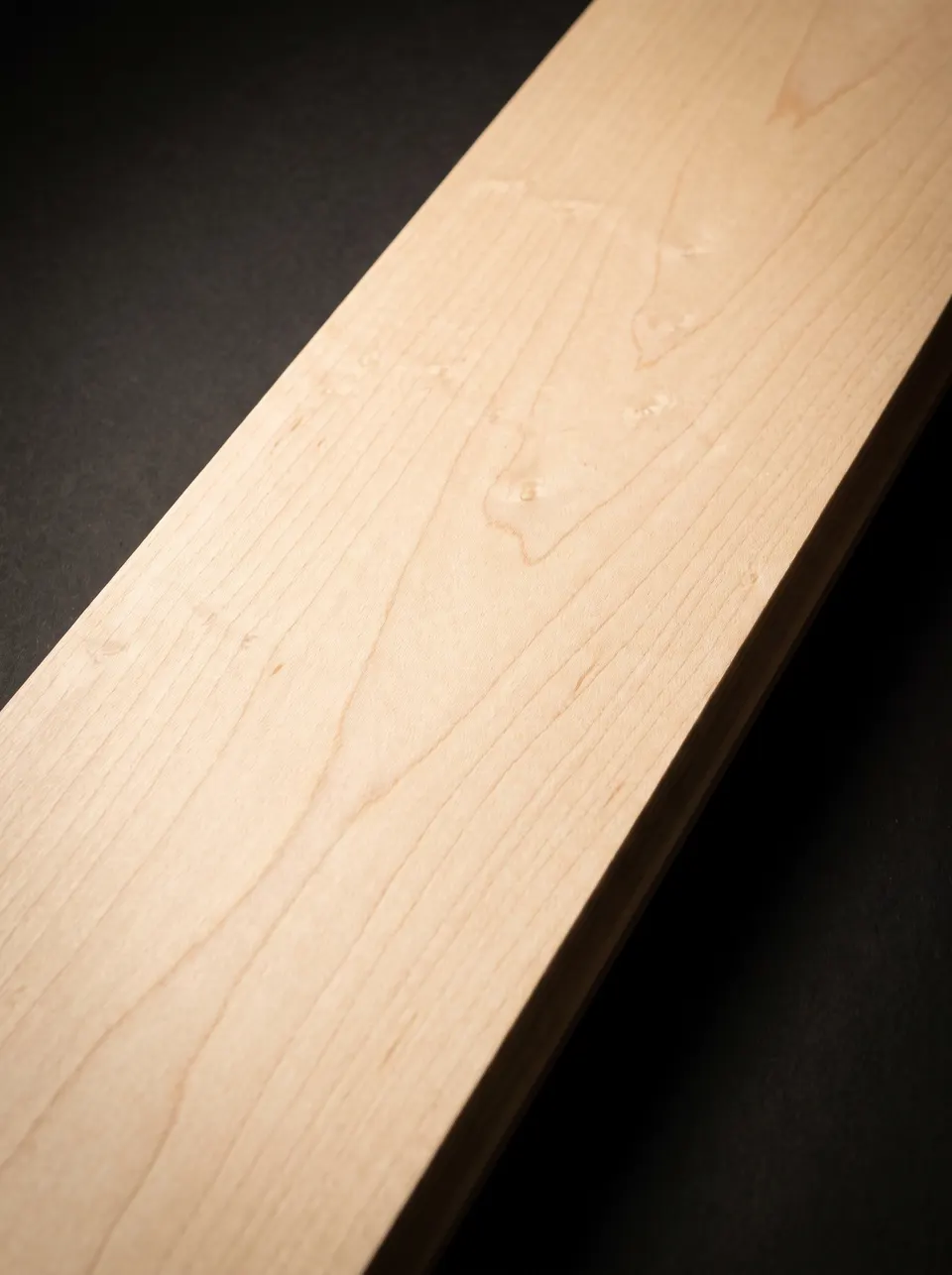
Hard maple at a glance
- Janka hardness
- 1,450 (hardest of the common domestic flooring species after hickory)
- Typical cuts
- Plain sawn; occasional birdseye or curly figure shows up as a feature, not a defect
- Common widths
- 2 1/4 and 3 1/4 inch strip in 1990s and 2000s subdivisions; 4 to 5 inch plank new
- Finishes it takes
- Water-based polyurethane to keep it pale; oil-based ambers it toward gold; light stains and whitewash only
- Color and grain
- Creamy white to pale tan with occasional mineral streaks; very fine, closed, nearly invisible grain
- Minnesota seasons
- Moves more than oak; expect winter gaps in solid strip; engineered over radiant
- Where it is used most
- Kitchens, modern main floors, gyms and sport courts, 1990s and 2000s homes in Plymouth and Maple Grove
What a hard maple floor looks like finished
Finished clear with water-based polyurethane, hard maple stays creamy white with a faint pink or tan blush, and the grain nearly disappears. From across a room it reads as a single pale surface, which is the point for homeowners who want the floor to recede behind furniture and light. Oil-based polyurethane turns it gold within a year, so if you want the pale look, say so when the finish is specified. Mineral streaks, the gray-brown lines through some boards, are natural and show up more in lower grades.
How hard maple handles stain, and why we keep it light
This is where maple earns its reputation. The grain is so dense and uneven in how it absorbs pigment that a dark stain comes out blotchy, with cloudy patches that no number of extra coats will hide. We have talked many homeowners out of a dark maple floor. If a dark floor is the goal, buy a dark species or stain white oak. In the pale range maple does well. A clear coat, a slight whitewash or a light natural stain all take evenly, and a water-based finish keeps the color honest for years.
Hard maple through a Minnesota winter and summer
Maple moves more than oak across the humidity swing, and it shows the movement more because the floor is so pale and uniform. A solid maple strip floor in a forced-air house will open hairline gaps every January and close them by July; that is normal and not a defect. What helps is a whole-house humidifier holding the air near 35 to 45 percent, acclimation in the house before install, and expansion room at the walls. Over radiant heat or below grade we install engineered maple, or we steer toward engineered white oak.
Where hard maple belongs in the house
Kitchens and main floors with a lot of light, where the pale color stays bright and the hardness handles chairs and dropped pans. The 1990s and 2000s subdivisions in Plymouth and Maple Grove are full of factory-finished maple now at refinishing age, and most of it sands and recoats well; the micro-bevels between prefinished boards come out in the sand. It is a poor fit for rustic rooms, where the lack of grain looks thin, and for anyone who wants a dark floor.
Where hard maple is the wrong answer
- Dark stain. Maple blotches under heavy pigment; if you want espresso or walnut tones, pick a darker species instead.
- Rustic or heavily grained rooms. Maple's plain face looks thin next to timber beams and stone; oak or hickory carries those rooms.
- Houses that run dry all winter without a humidifier. Maple shows seasonal gaps more than oak, and the pale floor makes every gap a dark line.
Questions about hard maple floors
Why does my maple floor look blotchy after staining?
Because maple's grain is dense and uneven in how it takes pigment, so dark stain soaks into some patches and sits on top of others. It is the species, not the sander. The fix is a full sand back to bare wood and a lighter color, or accepting the variation. We test on your boards before committing to any stain.
Is hard maple harder than oak?
Yes. Hard maple rates 1,450 on the Janka scale against 1,360 for white oak and 1,290 for red oak. In a house the gap is modest; all three handle furniture and traffic well. Maple's pale color hides fewer scratches than oak's grain does, so it can look more worn even though it is harder.
Can I refinish the prefinished maple from my 2000s house?
Yes. Factory-finished maple from that era sands to bare wood like any solid floor, and the micro-bevels between boards come out in the process, leaving a flat, site-finished look. Thickness is rarely a problem on a first refinish. Plan on a multi-day job and a water-based finish to keep the floor pale.
Services for hard maple floors
Other species we install
White oak, Red oak, Hickory, Black walnut. Compare them side by side.